

Shadow-Credit Valuation Tremors: The $1.8T Private Debt Reckoning
When Blue Owl Capital, a titan in the direct lending space, reported a noticeable uptick in payment-in-kind (PIK) income across its portfolio, it wasn't just a line item adjustment; it was a seismic sensor tripping in the deep ocean of private finance. This subtle shift—where borrowers pay interest with more debt rather than cash—signals that the "higher-for-longer" rate environment is finally eroding the bedrock of borrower solvency. The $1.8 trillion private credit market is currently experiencing Shadow-Credit Valuation Tremors: a widening fracture between the placid valuations reported by funds and the volatile economic reality facing their borrowers.
This divergence is no longer a theoretical risk debated in academic circles. It is a quantifiable lag that threatens to trap institutional liquidity behind gates of artificial stability. While public high-yield bond spreads widen and contract with market sentiment, private credit Net Asset Values (NAVs) have moved with the lethargy of a glacier. This disconnect is not a sign of superior risk management, but rather a structural artifact of valuation methodologies that are now facing their first true stress test in a decade.
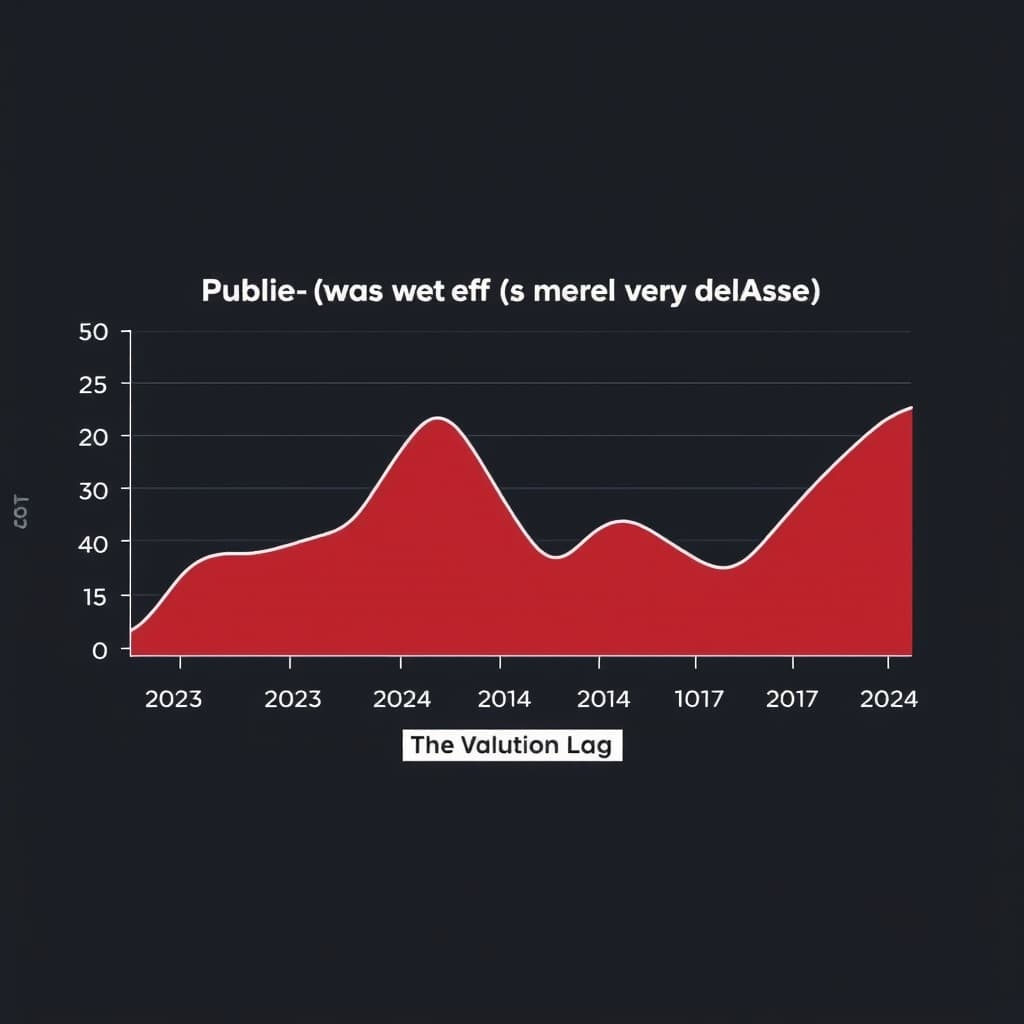
The Mark-to-Model Mirage: Anatomy of the Lag
The allure of private credit for pension funds and insurers has historically been its lack of correlation with public equity markets. However, this non-correlation is largely a function of accounting, not economics. Private loans are categorized as Level 3 assets under GAAP (Generally Accepted Accounting Principles), meaning their fair value is determined using "unobservable inputs" or internal models rather than live market prices.
Volatility Laundering in Practice
Asset managers typically revalue these loans quarterly, often relying on third-party valuation firms that use backward-looking data. When a public company’s debt trades down 15% in a week due to sector headwinds, a private lender to a similar company might only mark their loan down 1%—or not at all—arguing that the borrower’s long-term fundamentals remain intact.
This phenomenon, often termed "volatility laundering," serves a dual purpose:
- Investor Psychology: It prevents panic among limited partners (LPs) who might otherwise demand liquidity.
- Fee Preservation: Management fees are charged on assets under management (AUM); marking down assets reduces the fee pool.
The tremor occurs when the gap between the "model price" and the "clearing price" becomes too wide to ignore. We are currently seeing this in the disparity between where loans are marked on books (often near par, 97-100 cents) and where they trade in the secondary market (often 85-92 cents for stressed names).
Blue Owl and the Bellwether Stress Signals
As one of the largest and most sophisticated players in the arena, Blue Owl serves as the market's early warning system. When a manager of this caliber shows signs of credit migration, it implies that the broader, less disciplined middle market is likely facing more severe deterioration.
The Shift to Payment-in-Kind (PIK)
The most critical metric currently flashing yellow is the rise in PIK elections. PIK allows a borrower to defer cash interest payments by adding the interest amount to the principal balance. In a zero-rate environment, PIK is a growth tool; in a 5%+ rate environment, it is often a survival tactic.
Why PIK is the epicenter of the tremor:- Phantom Income: Lenders record PIK as income in their earnings, maintaining the appearance of yield, even though no cash was collected.
- Compounding Risk: The borrower’s debt load grows faster than their EBITDA, inevitably leading to a leverage cliff.
- Valuation Distortion: If a loan is converted to PIK because the borrower cannot pay cash, the loan should theoretically be marked down significantly to reflect higher default risk. Often, it is not.
Liquidity Mismatches and the Secondary Market Discount
The true price of any asset is what someone else is willing to pay for it today, not what a model says it will be worth at maturity. The secondary market for private credit stakes is currently calling the bluff on primary fund valuations.
The Bid-Ask Chasm
Institutional investors attempting to offload private credit stakes in the secondary market are encountering a harsh reality: buyers are demanding a liquidity premium. While a fund manager might report a NAV of $100, secondary buyers are bidding $85.
This discount implies that the market believes the book values are overstated. If a pension fund needs to rebalance its portfolio and sell these "stable" assets, they are forced to crystallize a loss that the manager has not yet recognized. This dynamic creates a "prisoner's dilemma" for LPs: the first to sell takes a haircut, but those who stay risk being gated.
Gating: The Dam Holding Back the Flood
To prevent a run on the bank, many private credit vehicles (especially semi-liquid structures like BDCs and interval funds) have gating mechanisms that limit withdrawals to 5% of the fund's assets per quarter. While this protects the fund's integrity, it destroys the liquidity promise sold to investors. When gates go up, confidence collapses, and the "shadow" valuation is exposed as illiquid paper wealth.
Regulatory Scrutiny and the Path to Repricing
Regulators are no longer asleep at the wheel. The sheer size of the private credit market—rivaling the high-yield bond and leveraged loan markets combined—has drawn the gaze of the SEC, the Federal Reserve, and the Financial Stability Board (FSB).
The Inevitability of Forced Transparency
The SEC's recent push for greater transparency in private fund reporting is just the opening salvo. We anticipate a regulatory pivot toward standardized valuation methodologies for Level 3 assets. If regulators mandate that private funds incorporate more "observable inputs" (i.e., public market comparables) into their models, we could see a sudden, systemic write-down of assets—a "mark-to-reality" event.
The Systemic Risk Loop:- Regulators demand stricter valuation.
- NAVs are written down by 10-15%.
- LPs breach allocation limits due to the denominator effect.
- Forced selling in the secondary market drives prices lower.
- The cycle feeds itself.
Strategic Outlook: The 2026 Prediction (The Signature Move)
The current divergence between public and private credit valuations is mathematically unsustainable.
Falsifiable Claim: By Q2 2026, the spread between the reported default rate in private credit (currently ~1-2%) and the implied default rate in the secondary trading market (currently pricing in ~5-6%) will converge. This convergence will not happen through secondary prices rising, but through primary book values falling by at least 800 basis points.
Watch these indicators to validate this thesis:- The "PIK Cap" Breach: Watch for major BDCs reporting PIK income exceeding 15% of total investment income. This is the tipping point where cash flow becomes insufficient to cover dividends.
- The "Amend and Extend" Wave: A spike in loan amendments where maturity is pushed out without a corresponding pay-down of principal.
- Audit Qualifications: An increase in auditors flagging "valuation uncertainty" in annual reports for private credit funds.
Conclusion
The eerie calm of the private credit market is fracturing. The rise in PIK income and the deep discounts in secondary trading are not anomalies; they are the initial tremors of a necessary repricing. Investors must look beyond the yield and scrutinize the valuation methodologies underpinning their portfolios. When the shadow lifts, the liquidity premium will be paid, and it will be expensive.
FAQ
What triggers a 'valuation tremor' in private credit? A tremor occurs when the internal "mark-to-model" valuations of illiquid loans diverge significantly from the price those assets would fetch in an open sale. This is often exposed during liquidity requests, secondary market transactions, or when borrowers shift to payment-in-kind (PIK) to avoid default.
Why is the $1.8 trillion market size concerning? The sheer scale of private credit means that opaque valuation practices are no longer a niche issue. A systemic repricing could trigger widespread liquidity freezes across pension funds, insurance companies, and endowments that rely on these assets for cash flow, potentially spilling over into the broader economy.
Sources
Loading comments...
Related
View all →