Conflict-Alpha Arbitrage: When Frontline Intel Bleeds into Prediction Markets
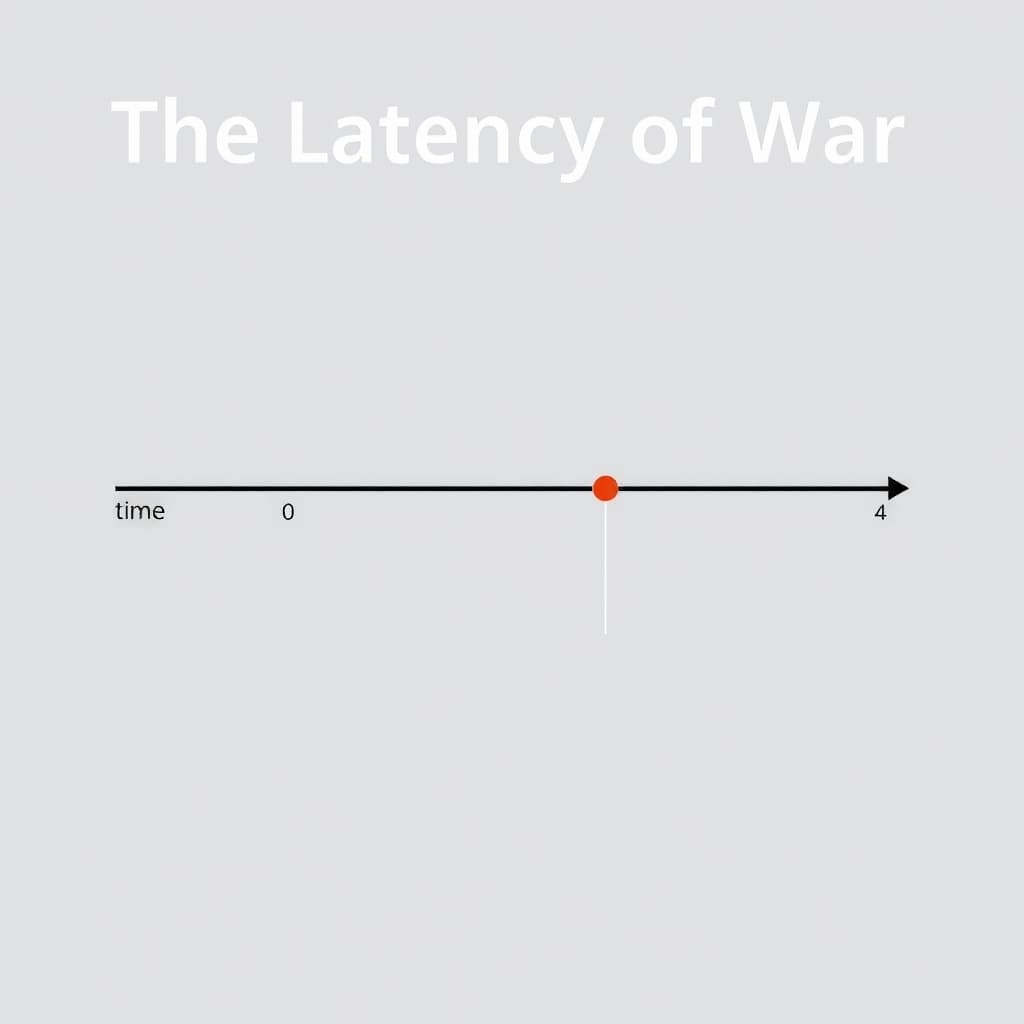
Three minutes. That is the rough average latency between a kinetic event on the ground—a raid, a hostage rescue, or a missile strike—and the subsequent confirmation by a "trusted" news wire like Reuters or AP. In high-frequency trading, microseconds matter. In decentralized prediction markets (DPMs), three minutes is an eternity during which the outcome is already known by the participants holding the rifles, yet the market remains open for betting.
This latency gap has birthed "Conflict-Alpha," a perverse financial incentive where operational security (OPSEC) violations are converted into yield. We are witnessing a structural failure in the permissionless market thesis: when the actors creating the history are also the ones betting on it, the market ceases to be a prediction engine and becomes a mechanism for insider arbitrage.
For strategists and compliance officers in the digital asset space, this is not a theoretical edge case. The recent reports involving Israeli Defense Forces (IDF) personnel allegedly betting on Gaza-related outcomes via Polymarket demonstrate that the "Oracle Problem" has shifted. It is no longer just about whether the data feed is accurate; it is about whether the market participant is the data source itself.
Weaponizing Asymmetric Information on the Blockchain
The fundamental value proposition of a prediction market is the aggregation of diverse information to form a probability consensus. However, this model collapses when "insiders" are not corporate executives with quarterly reports, but combatants with operational orders.
The Mechanics of Front-Running Oracle Latency
In a standard DeFi trade, arbitrageurs exploit price differences between exchanges. in Conflict-Alpha, the arbitrage is temporal. The soldier on the ground possesses "Material Non-Public Information" (MNPI) the moment a trigger is pulled.
The workflow operates on a distinct timeline:
- Event Zero: Operational action occurs (e.g., a ceasefire violation).
- The Insider Window: The soldier, or their direct network, accesses a DPM via a smartphone. Because the event has not hit the news wires (the "Oracle"), the market odds still reflect the pre-event reality.
- The Bet: The insider buys "Yes" shares at a discount (e.g., 40 cents).
- The Wire Flash: 10-30 minutes later, mainstream media reports the event.
- The Re-rate: The market adjusts to 99 cents. The insider exits or waits for settlement.
Why Traditional Filters Fail
Traditional finance (TradFi) relies on identity. If a Boeing executive dumps stock the day before a crash report, the SEC tracks the trade to a KYC’d identity.
DPMs, by design, often lack this layer at the protocol level. While frontend interfaces may implement geoblocking, the smart contracts on networks like Polygon or Gnosis are permissionless. A wallet address is an alphanumeric string, not a rank or serial number. Furthermore, the "insider" definition in current securities law is poorly adapted to warfare. A soldier is not a corporate officer, and a raid schedule is not a balance sheet, yet the financial outcome is identical.
The Gaza-Polymarket Nexus: A Case Study in Kinetic Arbitrage
The surge in volume on Middle East geopolitical contracts in late 2023 and 2024 provided a live-fire stress test for this vulnerability.
Converting OPSEC into Yield
Reports indicate that IDF personnel utilized their knowledge of upcoming operations to trade on contracts such as "Hamas to be eliminated by [Date]" or specific hostage rescue scenarios. This creates a dual-hazard:
- Financial Rigging: The market is effectively deciding the payout for an event the bettor controls.
- Perverse Incentives: If a soldier stands to make 100% returns on a "No Ceasefire" bet, the financial incentive aligns with prolonging conflict, introducing a moral hazard that goes beyond financial compliance and into international humanitarian law.
OSINT vs. Non-Public Operational Parameters
It is vital to distinguish between Open Source Intelligence (OSINT) and Conflict-Alpha.
- OSINT: A trader analyzes satellite data, telegram channels, and flight paths to predict a strike. This is legitimate research and contributes to market efficiency.
- Conflict-Alpha: A trader knows the strike is happening because they are in the command tent.
The line blurs when soldiers use their phones. While militaries strictly forbid phones in secure zones (SCIFs), the battlefield is porous. Starlink terminals and local cellular networks allow data egress even from active combat zones. The "fog of war" is now a liquidity pool.
Regulatory Firewalls and the Geofencing Fallacy
Regulators are attempting to apply 20th-century jurisdictional rules to a technology that is inherently non-local.
The Limitations of IP Blocking
Most compliant DPM frontends block IP addresses from sanctioned nations or active conflict zones. This is security theater.
- VPNs: Trivial to bypass.
- Starlink: A Starlink terminal in Gaza might route traffic through a ground station in Germany or Italy. To the protocol, the soldier appears to be a European civilian.
- Direct Contract Interaction: Sophisticated users bypass the web interface entirely, interacting directly with the smart contract via Etherscan or custom scripts, ignoring all frontend geofences.
The CFTC and "Event Contracts"
The U.S. Commodity Futures Trading Commission (CFTC) has proposed rules to ban "event contracts" related to terrorism, assassination, and war. Their primary argument is moral, but the structural argument is stronger: these markets are impossible to police for manipulation.
If the CFTC defines these contracts as "gaming" or "illicit," they drive liquidity offshore or into dark pools. However, if they regulate them, they must define who a "combatant insider" is. Does a logistics officer handling ammunition supply counts count as an insider? The complexity of defining the "exclusion list" for a war prediction market renders enforcement nearly impossible without strict identity verification.
Strategic Trade-offs: Mitigation Options
Platforms face difficult choices to curb this behavior. None are perfect.
The Future of Kinetic Finance: 2026 and Beyond
As we look toward the next cycle of decentralized applications, the integration of kinetic events into finance will likely face a hard fork.
Smart Contract "War Clauses"
We anticipate the development of standard "War Clause" modules in Oracle design. Similar to circuit breakers in the NYSE, these modules would automatically pause trading on a specific market if volatility spikes beyond a standard deviation within a set timeframe (indicating potential insider knowledge leakage) or if a trusted Oracle flags an "Active Kinetic Event."
The Inevitable Clash
The tension between the cypherpunk ethos ("code is law") and the laws of war is approaching a breaking point. If a decentralized protocol is viewed as facilitating the financing of combatants—or worse, incentivizing specific tactical outcomes for profit—international bodies like the FATF (Financial Action Task Force) will not just regulate the frontends; they will target the developers and the liquidity providers.
What Would Change My Mind
I would reconsider the severity of this threat if Zero-Knowledge (ZK) Identity solutions mature rapidly. If a protocol can verify "User is NOT active military personnel" via a ZK-proof linked to a government database without revealing the user's actual identity, we could filter combatants while preserving privacy. However, until militaries open their personnel databases to ZK-verifiers (highly unlikely), this remains a pipe dream.
Conclusion
The digitization of warfare has expanded beyond cyberattacks and drone inputs to include a financial derivative layer. Conflict-Alpha is not merely a compliance headache; it is a validation crisis for prediction markets. If protocols cannot solve the oracle problem regarding classified actors, the "wisdom of the crowd" will be usurped by the "profit of the platoon." Without architectural changes to how these markets settle and filter participants, regulators will be justified in shutting down conflict-based order books entirely.
FAQ
Is betting on war zones considered insider trading? In traditional finance, insider trading requires a breach of fiduciary duty or misuse of non-public material information defined by securities laws. While DeFi occupies a grey zone, utilizing classified military operational data for personal gain violates military law (UCMJ or equivalent) and likely constitutes wire fraud under broad regulatory interpretations.
Can prediction markets ban active soldiers from trading? Technically, no. Without strict KYC (Know Your Customer) linking wallets to real-world identities, protocols cannot distinguish between a frontline soldier, an OSINT analyst, or a random speculator. IP blocking is ineffective due to VPNs and satellite internet routing.
Sources
Loading comments...
Related
View all →