
Privatized Connectivity Interdiction: When Tech CEOs Become War Regulators
Defense planners and corporate strategists currently face a binary risk that did not exist a decade ago: rely on superior, low-latency commercial satellite networks and cede operational control to a mercurial CEO, or rely on antiquated sovereign military systems and lose the bandwidth war. This analysis dissects the mechanism of "Privatized Connectivity Interdiction"—the capacity of private entities to remotely dismantle military logistics—and evaluates the regulatory vacuum that allows Terms of Service to supersede the Geneva Conventions.
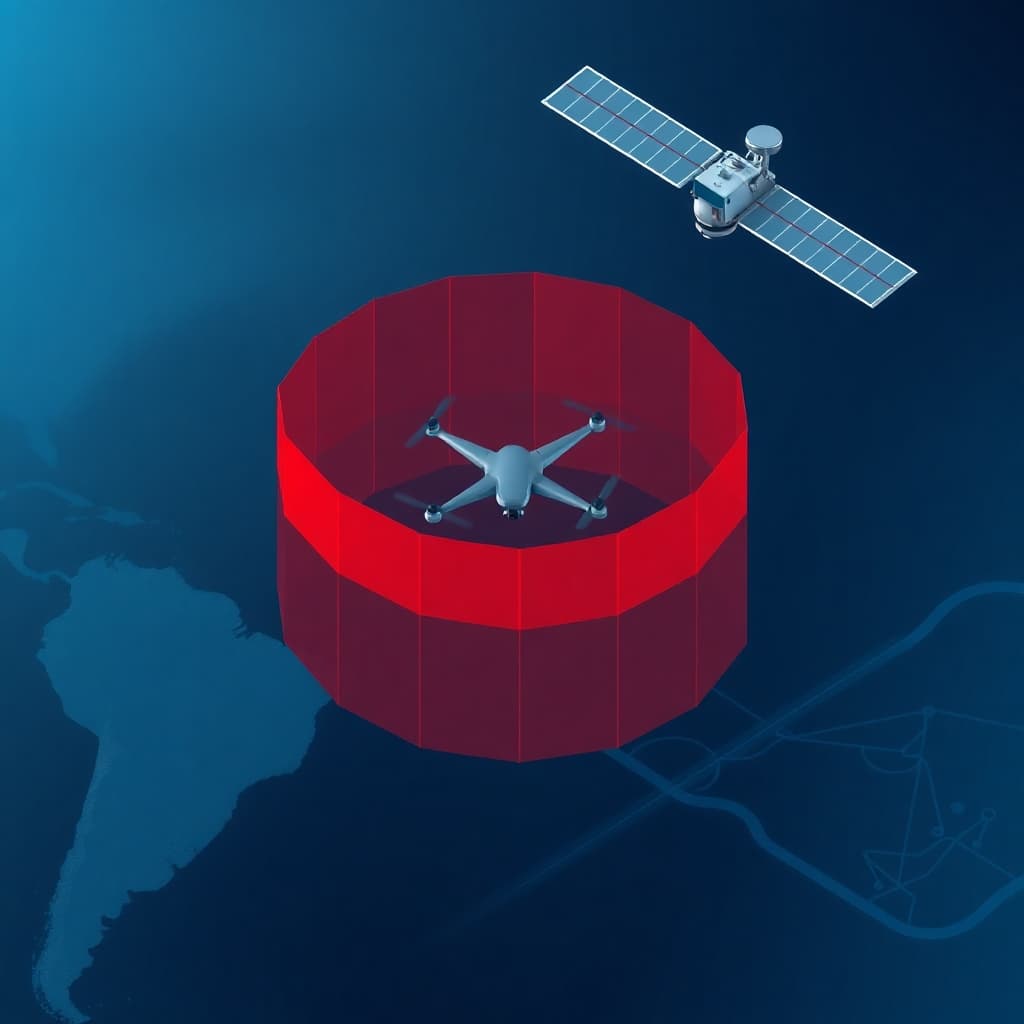
The era of state-monopolized arms control has effectively collapsed. While governments debate export controls on semiconductors, commercial satellite providers have demonstrated a far more potent capability: the unilateral degradation of military assets through software-defined geofencing. As evidenced by the grounding of drone swarms in conflict zones following service revocations, the "kill switch" for modern warfare is no longer in a general’s briefcase, but in a sysadmin’s console in Redmond or Hawthorne.
The Mechanics of Digital Denial: Geofencing as a Weapon
The lethality of modern interdiction lies not in kinetic strikes but in the denial of the digital handshake. Traditional arms control focuses on preventing hardware from crossing borders. However, in a software-defined conflict, the hardware is irrelevant if the network layer rejects it.
Precision IP Filtering and Cell-Based Locking
Commercial Low Earth Orbit (LEO) providers utilize beamforming and cell-based locking protocols that offer granular control over service areas, often down to a few square kilometers. Unlike geostationary satellites which blanket entire hemispheres, LEO constellations manage connectivity via dynamic cells.
When a provider decides to interdict, they do not need to jam a signal. They simply update the whitelist. The user terminal requests a handshake; the satellite identifies the terminal’s GPS coordinates and unique hardware ID. If those coordinates fall within a "gray zone" or the ID is flagged as belligerent, the satellite refuses the uplink. The terminal becomes a brick instantly. This is precision de-platforming applied to ballistics.
The Shift from Hardware to Real-Time Bricking
We have witnessed a fundamental inversion in logistics. Previously, if a smuggler managed to get a radio across a border, the device worked until it was jammed or destroyed. Today, the physical possession of a Starlink or OneWeb terminal is insufficient. The "product" is a continuous service subscription.
This creates a dependency vulnerability. A state actor relying on commercial off-the-shelf (COTS) technology effectively invites the vendor into their chain of command. The vendor can update firmware to disable specific features (e.g., preventing usage above certain speeds or altitudes) or brick the unit entirely based on usage patterns that resemble automated drone guidance rather than human browsing.
Grounding the Swarm: The Starlink Blackout Effect
The conflict in Ukraine and subsequent skirmishes involving Russian utilization of illicit terminals provided the proof of concept for Privatized Connectivity Interdiction. The timeline reveals a chaotic tug-of-war between black-market procurement and centralized network administration.
Forensic Analysis of the Grounding Timeline
When reports surfaced of Russian forces utilizing third-party procured terminals for drone coordination, the initial response was bureaucratic inertia. However, once the provider initiated a "crackdown," the effects were immediate. Telemetry data suggests that entire sectors of the front experienced a coordination blackout.
The effectiveness of this interdiction stems from the centralized nature of LEO constellations. Unlike the internet, which is a mesh of decentralized networks, a satellite constellation is a walled garden. The provider has total visibility into the signal strength, location, and data throughput of every terminal. When the decision was made to enforce the "No Military Use" clause, it bypassed the need for diplomatic sanctions. It was a server-side update.
Why Smuggling Fails Against Network-Layer ID
Smugglers successfully routed thousands of terminals through intermediate countries, bypassing physical customs checks. Yet, this hardware arbitrage failed against network interrogation. Every terminal broadcasts a unique identifier. By cross-referencing these IDs with the geolocation of the uplink request, providers could identify terminals sold to Dubai or Kazakhstan that were inexplicably requesting service from the Donbas region.
The provider then faces a choice: disable the terminal (enforcing interdiction) or allow it (becoming a de facto arms supplier). The decision is made based on corporate risk appetite, not national security policy.
Terms of Service as the New Rules of Engagement
We have reached a point where a User Agreement carries more weight on the battlefield than International Humanitarian Law (IHL). This creates a dangerous legal and ethical gray zone where corporate liability shields clash with the realities of war.
Liability Shields vs. International Humanitarian Law
Corporations are structured to minimize liability and maximize shareholder value. When a tech CEO restricts service to prevent "offensive use," they are arguably complying with their own Terms of Service to avoid being classified as a weapons manufacturer or a combatant.
However, this neutrality is illusory. By selectively providing connectivity to one side while denying it to another—or denying it to both in specific zones—the provider is actively shaping the battlespace. Legal scholars argue that if a sysadmin knowingly disables connectivity used for medical evacuation or critical infrastructure during a siege, the company could theoretically be liable under IHL. Yet, the current framework treats these actions as simple contract disputes.
The Blurred Line: Neutral Service Provider or Active Combatant?
If a commercial satellite transmits targeting data that leads to a lethal strike, is the satellite operator a participant in hostilities? Conversely, if the operator turns off the service to prevent that strike, are they interfering in a sovereign nation's self-defense?
The distinction between "dual-use" and "military-grade" has evaporated. The same high-bandwidth connection used for a Zoom call is used to pilot a kamikaze drone. Commercial providers are forcing themselves into the role of arbiter, determining which packets are peaceful and which are lethal. This is a regulatory burden they are ill-equipped to handle, yet they currently hold the gavel.
Strategic Trade-offs: The Connectivity Dilemma
State actors and defense contractors must now weigh the cost of autonomy against the cost of capability.
Beyond LEO: The Future of Autonomous Interdiction (2026-2030)
The next phase of this conflict will move from manual policy enforcement to automated, AI-driven policing of the spectrum.
AI-Driven Anomaly Detection
By late 2026, we expect major providers to implement automated "Packet Policing." Using machine learning models trained on the data patterns of the Ukraine and Gaza conflicts, networks will automatically flag and throttle connections that exhibit "kill chain signatures"—such as the specific latency and upstream/downstream ratios associated with drone video feeds or artillery fire control apps. This will happen in real-time, without human intervention, effectively creating an automated demilitarized zone in the ether.
The Rise of Sovereign, Air-Gapped Constellations
The response from nations like China, Russia, and Iran is inevitable: the total rejection of Western commercial connectivity. The "Splinternet" is ascending to orbit. We will see the deployment of sovereign constellations that are hardware-incompatible with Western networks. These systems will lack the "conscience" mechanisms of their Western counterparts, designed specifically to be immune to the moral whims of a CEO or the regulatory pressure of the US State Department.
What Would Change My Mind?
The threat of privatized interdiction assumes that hardware remains proprietary and locked to a specific provider. However, if the industry is forced toward open standards—specifically the widespread adoption of 3GPP 5G Non-Terrestrial Network (NTN) standards—the power of the individual provider diminishes. If a user terminal becomes a generic commodity capable of roaming between Starlink, Kuiper, and OneWeb seamlessly, no single CEO can enforce a blackout. The market would become a utility, stripping the tech oligarchs of their regulatory power. Until interoperability is mandated by law, however, the walled gardens remain fortresses.
The Regulatory Clawback
Private entities currently hold the kill switch for modern logistical chains, a reality that national security apparatuses will not tolerate indefinitely. The window where a CEO can unilaterally dictate the boundaries of a conflict is closing. We are approaching a regulatory correction where governments will likely mandate "must-carry" provisions for defense contracts, effectively nationalizing the control logic of these constellations during wartime, regardless of who owns the satellites.
FAQ
What constitutes privatized connectivity interdiction? It refers to the capability of private commercial entities to selectively deny critical communications infrastructure to belligerents in a conflict zone, often overriding state-level military objectives through Terms of Service enforcement.
How effective is geofencing against smuggled satellite terminals? Highly effective. While hardware can be smuggled, the network requires a digital handshake that reveals the terminal's precise GPS location and unique ID, allowing providers to remotely disable unauthorized units instantly regardless of physical possession.
Sources
- Department of Defense: Commercial Space Integration Strategy
- SpaceX Terms of Service - Starlink
- ICRC: International Humanitarian Law and Cyber Operations
- CSIS: Counter-Space Operations and the Role of Commercial Actors
- Electronic Frontier Foundation: Satellite Internet and Censorship
- 3GPP Release 17: Non-Terrestrial Networks (NTN) Standards
Loading comments...
Related
View all →