Deep Analysis
Bittensor (TAO) Valuation Mechanics: Decoding Subnet Subsidies and the $365 Breakout
March 25, 2026
...


Capital allocators navigating the digital asset space in Q1 2026 face a distinct binary risk regarding XRP: deploying capital into a stagnant $1.36 consolidation zone, or holding dry powder for a high-probability liquidity sweep down to $1.20. Making this decision requires looking past retail sentiment and analyzing the structural realities of the derivatives market, macro liquidity constraints, and the finalized implementation of enterprise messaging standards.
By dissecting the recent collapse in open interest CoinGlass data alongside the end of the SWIFT MT-to-MX coexistence period, we can strip away the noise and model the true institutional accumulation parameters for Q2 2026.
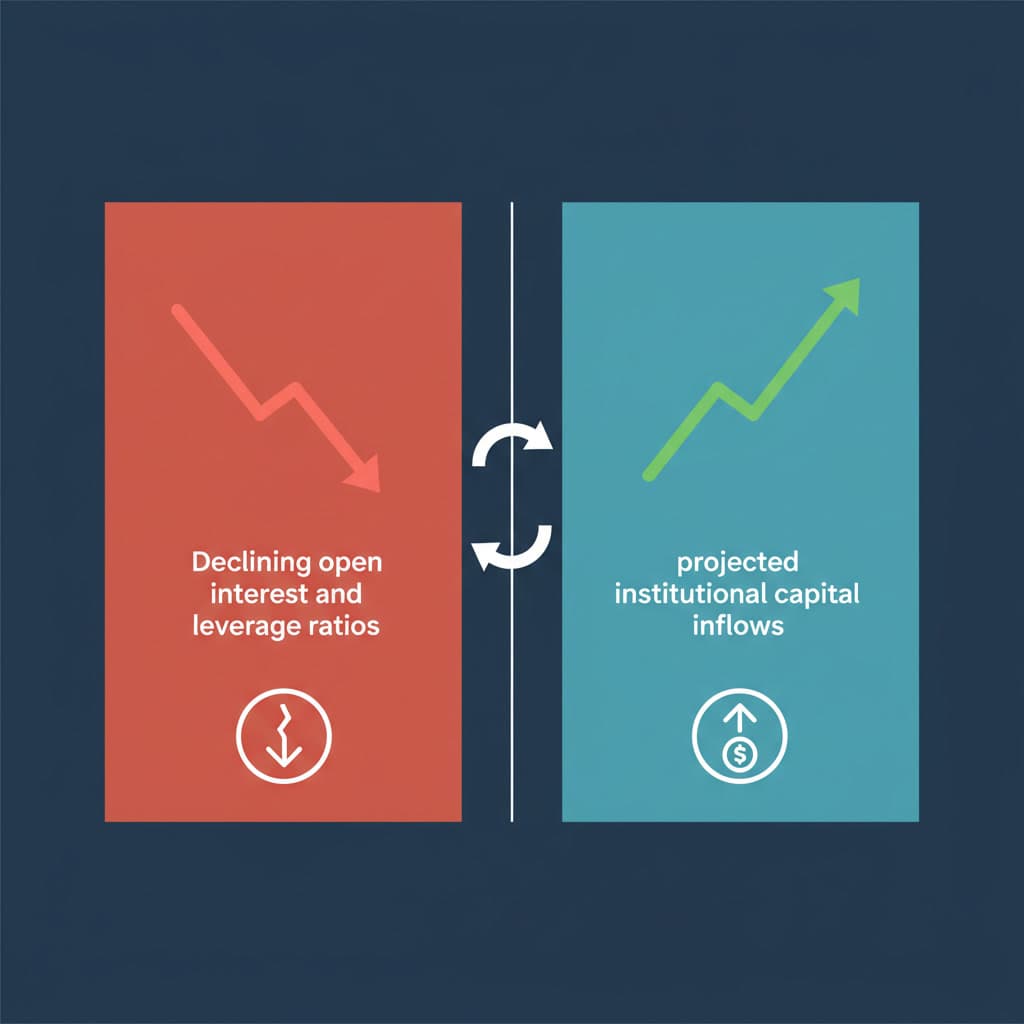
The defining characteristic of XRP’s current market structure is not its price action, but the aggressive deleveraging that has occurred beneath the surface. Open interest has compressed significantly, signaling a fundamental shift in how the asset is being traded.
Open interest (OI) for XRP currently sits near $2.53 billion, a drastic reduction from the $10.94 billion peak observed during previous cycle highs. This drop in OI, coupled with a yearly low in leverage ratios, fundamentally alters the asset's volatility profile.
When leverage ratios compress, the threat of cascading liquidations—where forced selling triggers further margin calls—diminishes. The market transitions from being heavily financialized and driven by perpetual futures manipulation to being anchored by spot market dynamics. For institutional desks, a low-leverage environment is a prerequisite for entry. It provides the necessary friction to absorb large block trades without causing outsized slippage or triggering algorithmic spoofing from high-frequency trading firms.
Despite the healthier leverage profile, the current $1.36 level remains structurally fragile. Market makers and algorithmic execution engines inherently seek liquidity pockets to fill large orders. The gap between the current price and the $1.20 support zone contains unmitigated imbalances—areas where price moved too quickly in previous weeks, leaving a vacuum of resting bid liquidity.
A drop to $1.20 should not be viewed as a fundamental breakdown, but rather as a necessary mechanical sweep. By driving the price into this zone, institutional algorithms can trigger the stop-losses of late-stage retail longs, capturing the necessary liquidity to build substantial Q2 positions without driving up their own average entry price.
The ongoing consolidation is a byproduct of conflicting capital flows. Retail participants are exhausting their capital on short-term momentum plays, while enterprise entities are quietly adjusting their allocation strategies based on stringent risk-adjusted return metrics.
Retail trading volume acts as a double-edged sword. While it provides baseline liquidity, heavy retail traffic often introduces fragmented resistance layers. Retail participants holding underwater positions from previous rallies create artificial supply walls. Every minor upward price movement is met with selling pressure from retail traders looking to break even.
This stagnation deters algorithmic block purchasing. Smart money execution algorithms are programmed to halt accumulation when retail selling pressure creates inefficient fill rates. Until retail capitulation clears these overhead supply walls, institutional capital will remain passive, allowing the price to drift sideways.
The institutional landscape for XRP in 2026 is highly bifurcated. While surveys from entities like MEXC suggest a "quarter of institutions are set to invest," actual on-chain and ETF fund flows present a more nuanced reality.
Consider the recent activity in spot XRP ETFs. On a typical trading day in late March 2026, Bitwise’s XRP ETF was the sole source of positive inflows, capturing roughly $977,860, while other funds recorded muted or zero activity. This mini case study illustrates that institutional demand is highly selective. Capital is not flooding the asset blindly; it is being deployed via regulated, compliant vehicles at precise technical support levels. The divergence between broad bullish sentiment and actual "wobbly" institutional interest suggests that smart money is waiting for macro conditions to stabilize before committing heavy capital.
Digital assets do not exist in a vacuum. XRP’s utility as a cross-border settlement mechanism makes it uniquely sensitive to global macroeconomic policies and geopolitical stability.
The escalation of tensions in the Middle East, specifically between the US and Iran, has triggered a classic flight-to-safety rotation within the crypto ecosystem. Bitcoin recently surged past $70,830 as it solidified its narrative as a non-sovereign geopolitical hedge. Conversely, high-beta altcoins and utility tokens like XRP slipped toward $1.36.
When geopolitical risk spikes, capital allocators reduce exposure to assets heavily reliant on global trade and cross-border payment utility. The immediate second-order effect is a temporary drain of liquidity from the XRP ledger into perceived safe havens, suppressing price action regardless of the protocol's fundamental developments.
The Federal Reserve’s hawkish stance throughout early 2026 has effectively ended the era of cheap, synthetic liquidity. For enterprise blockchain solutions, the cost of capital is a critical constraint. RippleNet’s On-Demand Liquidity (now Ripple Payments) requires market makers to hold inventory and facilitate instant cross-border swaps.
When interest rates remain elevated, the opportunity cost of holding non-yielding digital assets increases. Financial institutions are forced to be far more rigorous in their treasury management. The "end of cheap liquidity" means XRP must prove its deflationary utility and cost-saving metrics in real-time, rather than relying on speculative future adoption narratives.
The technological foundation of XRP is currently undergoing its most significant stress test to date, driven by the global banking sector's mandatory shift in messaging standards.
The coexistence period for SWIFT’s legacy MT messages ended in November 2025. As of 2026, the global financial system relies exclusively on the ISO 20022 format for cross-border bank-to-bank payment instructions.
While retail speculators assumed this transition would act as an immediate catalyst for XRP, the reality is far more structural. ISO 20022 is a data-rich messaging standard, not a settlement network. The actual throughput on the XRP Ledger (XRPL) remained stable at approximately 22 transactions per second during the initial transition. The true value accrual for XRP in 2026 stems from Ripple’s integration into this new standard, allowing the XRPL to act as a seamless, compliant settlement layer beneath the ISO 20022 messaging infrastructure.
Ripple’s official membership in the ISO 20022 Registration Management Group ensures that its payment infrastructure natively supports the schema validation and digital signing required by modern banking.
The integration allows a bank to send an ISO 20022 compliant message detailing a transaction, while the actual value is routed, converted, and settled via XRP in seconds. The adoption curve here is slow and methodical, requiring rigorous compliance checks, but it establishes a permanent utility floor for the asset. Falsifiable Claim: XRP will fail to sustain any breakout above the $1.55 macro resistance level in Q2 2026 unless enterprise-grade Escrow wallet movements (excluding routine first-of-the-month Ripple unlocks) increase by at least 40% quarter-over-quarter.
This claim can be validated or refuted by monitoring three specific indicators:
If the Federal Reserve executes an unexpected dovish pivot, aggressively cutting rates and injecting synthetic USD liquidity into the system, the cost of capital constraint would vanish. Under those conditions, algorithmic risk models would immediately re-rate high-beta utility assets, potentially invalidating the requirement for a $1.20 liquidity sweep and forcing early institutional entries at current levels.
The $1.36 valuation represents a purgatory between retail exhaustion and institutional deployment. The derivatives reset has successfully cleared the speculative excess, establishing a much healthier market structure. However, until the macro liquidity environment softens and the fragmented retail supply is fully absorbed, XRP will likely rely on strategic liquidity sweeps to fuel its next phase of organic price discovery. Monitoring on-chain enterprise wallet flows, rather than retail sentiment or geopolitical noise, remains the only reliable metric for timing capital deployment in 2026.
How does the recent drop in XRP leverage ratio affect short-term price stability? A lower leverage ratio indicates reduced speculative excess in the derivatives market, decreasing the likelihood of cascading liquidations and establishing a stronger fundamental floor for organic price discovery.
Why is retail trading volume currently viewed as a headwind for XRP? Heavy retail volume often introduces localized volatility and fragmented resistance levels, which can temporarily deter large-scale institutional block purchases until a clearer accumulation phase emerges.
Loading comments...