
Deep Analysis
Solana (SOL) Institutional Outlook: Breaking Down the $85 Support Defense and 2026 Ecosystem Metrics
March 24, 2026
...


The recent 15% daily surge pushing Bittensor (TAO) past $365 is widely celebrated as a triumph of decentralized artificial intelligence, but beneath the surface, it is a liquidity mirage engineered by aggressive token subsidies and dangerously skewed derivatives positioning. Analyzing the structural gap between institutional exchange-traded product inflows and the organic compute demand across the network’s top subnets reveals a severe protocol-level deficit. This quantitative evaluation bridges Bittensor’s token emission schedule with current market microstructure to separate fundamental utility from speculative leverage, providing an institutional-grade framework for pricing TAO in 2026. For foundational data on the asset's current market capitalization and circulating supply, refer to CoinMarketCap's TAO aggregate metrics.
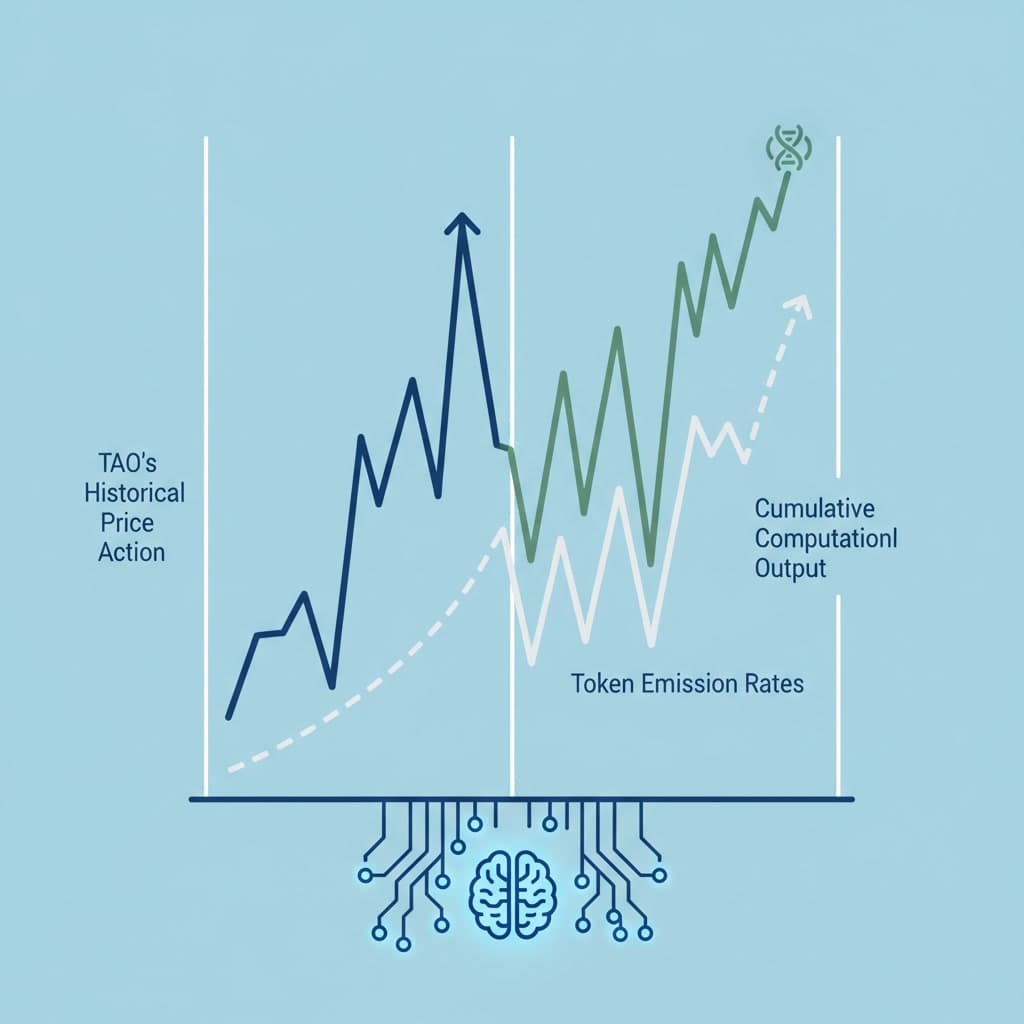
Bittensor operates on a unique consensus mechanism known as Yuma Consensus, which systematically decouples the generation of machine intelligence from its validation. Miners deploy proprietary machine learning models or raw compute to solve specific tasks, while validators evaluate the accuracy and latency of these outputs. The protocol rewards both sides with TAO emissions based on their performance scores.
The mechanism is elegant in theory. In practice, it creates a closed-loop economy highly dependent on continuous token inflation. Validators are financially incentivized to align with the consensus of other validators rather than strictly optimizing for real-world API utility. This dynamic effectively subsidizes compute availability rather than actual consumer utilization, leading to a network architecture that excels at benchmarking but struggles with enterprise-grade commercialization.
The network is partitioned into specialized subnets, each functioning as a distinct micro-economy for tasks ranging from text prompting to protein folding. Subnet 3, for instance, recently garnered attention for permissionlessly training a 72-billion-parameter language model (Covenant-72B) across dozens of distributed contributors.
While technical milestones like distributed stateful training demonstrate the architecture's viability, the compute demand across the top 10 subnets remains heavily synthetic. Miners participate primarily to farm TAO emissions, not to service external API calls. If organic, fiat-denominated demand does not materialize to replace the newly minted TAO, the operational cost of maintaining these high-performance subnets will collapse the moment emission schedules contract.
To understand TAO’s valuation risk, one must quantify the "income desert" separating protocol inflation from external revenue. Subnet 64 (Chutes) serves as the perfect case study. Capturing approximately 14.4% of total network emissions, this single subnet receives roughly 518 TAO daily,. At recent baseline prices, this translated to a $52 million annualized operational subsidy,. With TAO currently trading at $365, that annualized subsidy run-rate expands beyond $68 million.
Contrast this inflation with actual commercial traction. External annualized revenue for Chutes is estimated between $1.3 million and $2.4 million. The network is currently inflating $22 to $40 in newly minted TAO to subsidize every $1 paid by actual users. This is not operational efficiency; it is venture capital burn disguised as protocol consensus.
The halving event in December 2025 reduced daily network emissions from 7,200 to 3,600 TAO,. This emission decay forces a brutal reality onto miners: they must either double their operational efficiency or rely on exponential price appreciation to justify their hardware costs.
Removing the token subsidy reveals that inference costs on top Bittensor subnets are currently 1.6x to 3.5x more expensive than centralized alternatives like TogetherAI or DeepSeek. As we move deeper into 2026, the second-order effect of this income desert will be a miner exodus. If the network cannot transition from an inflation-funded model to a customer-funded model, the $1.37 billion aggregate valuation of these subnets will face a severe repricing,.
Narrative velocity often outpaces fundamental revenue in digital assets, and TAO recently received the ultimate narrative catalyst. During an appearance on the All-In Podcast, NVIDIA CEO Jensen Huang highlighted Bittensor's Subnet 3 training of a 4-billion-parameter Llama model,. Huang characterized the distributed training as a "pretty crazy technical accomplishment" and explicitly likened it to "our modern version of Folding@home".
This endorsement acted as a structural green light for institutional speculators. By framing Bittensor not as crypto theater, but as a legitimate expression of distributed coordination, Huang validated the coexistence of proprietary and open-source AI infrastructure. Retail and institutional traders immediately repriced the asset, ignoring the income desert in favor of the hardware validation.
The speculative premium is currently being absorbed by structural market plumbing. Grayscale’s December 2025 S-1 filing to convert its Bittensor Trust into a spot ETF (GTAO) on NYSE Arca fundamentally alters TAO's liquidity profile.
Regulated Exchange Traded Products introduce persistent, price-agnostic buy pressure. As wealth managers and pension funds allocate a fraction of their portfolios to decentralized AI infrastructure, these funds must acquire spot TAO, effectively shrinking the circulating supply. This institutional hoarding masks the inflationary pressure of the miner subsidies, creating a temporary supply shock that drives the price toward local highs.
The break past $365 is not entirely spot-driven. Derivatives open interest reveals a market dangerously tilted toward the upside, with the long leverage ratio sitting at a precarious 80%. When perpetual futures traders overwhelmingly crowd one side of the order book, the asset becomes highly susceptible to liquidation cascades.
If spot ETF inflows decelerate even marginally, the funding rates required to maintain these leveraged long positions will become mathematically unsustainable, triggering forced selling regardless of the underlying protocol developments.
The chart structure indicates that TAO has cleared its immediate moving averages, but the psychological and technical barrier at $500 looms large. The descent from the November 2025 peak established heavy distribution zones that will require immense spot volume to breach.
Signature Falsifiable Claim: I hypothesize that TAO will suffer a 30% leverage flush, testing the $260 support band, before it can successfully break the $500 resistance level.
Indicators that will confirm or refute this trajectory:
The current valuation of Bittensor represents a tug-of-war between profound technical achievements and unsustainable economic subsidies. The network has undeniably proven that decentralized, stateful training of large language models is possible using consumer-grade hardware,. However, an architecture that relies on $50+ million annual subsidies to generate $2 million in real revenue is fundamentally mispriced. The coming quarters will dictate whether institutional capital inflows can buy the protocol enough time to cross the income desert, or if the 80% long leverage will violently snap the market back to fundamental reality.
What is the Bittensor 'income desert' and how does it affect TAO? The income desert refers to the current gap between organic network-generated revenue and the token subsidies paid to miners and validators. Heavy token emissions currently subsidize the network, which poses a long-term valuation challenge if real-world enterprise demand does not eventually outpace these emissions. Without external revenue, unsubsidized compute costs on the network are significantly higher than centralized alternatives.
How do institutional ETP listings impact TAO's market structure? Exchange Traded Products provide a regulated framework for traditional financial entities to gain direct exposure to TAO. This institutional access introduces structural buy pressure, deepens market liquidity, and reduces the asset's historical reliance on retail spot trading volume by absorbing circulating supply directly into custodial cold storage.
Loading comments...