
Deep Analysis
Grayscale's HYPE ETF Filing and Hyperliquid's Path to $100: Institutional Deep Dive
March 21, 2026
...


Micro-cap meme tokens like Peanut the Squirrel (PNUT) are widely dismissed as purely retail-driven gambling vehicles, yet their underlying market structures often exhibit highly predictable liquidity constraints that systematic arbitrageurs can exploit. Applying quantitative liquidity analysis and order book imbalance modeling to PNUT’s current $0.043 valuation reveals a sophisticated micro-structure beneath the surface. Operating on the Solana blockchain as a standard SPL token, PNUT presents unique execution challenges for institutional portfolios seeking non-correlated beta.
For real-time tracking of these metrics, CoinGecko's PNUT data provides baseline volume aggregates, though deeper on-chain parsing is required for institutional execution.
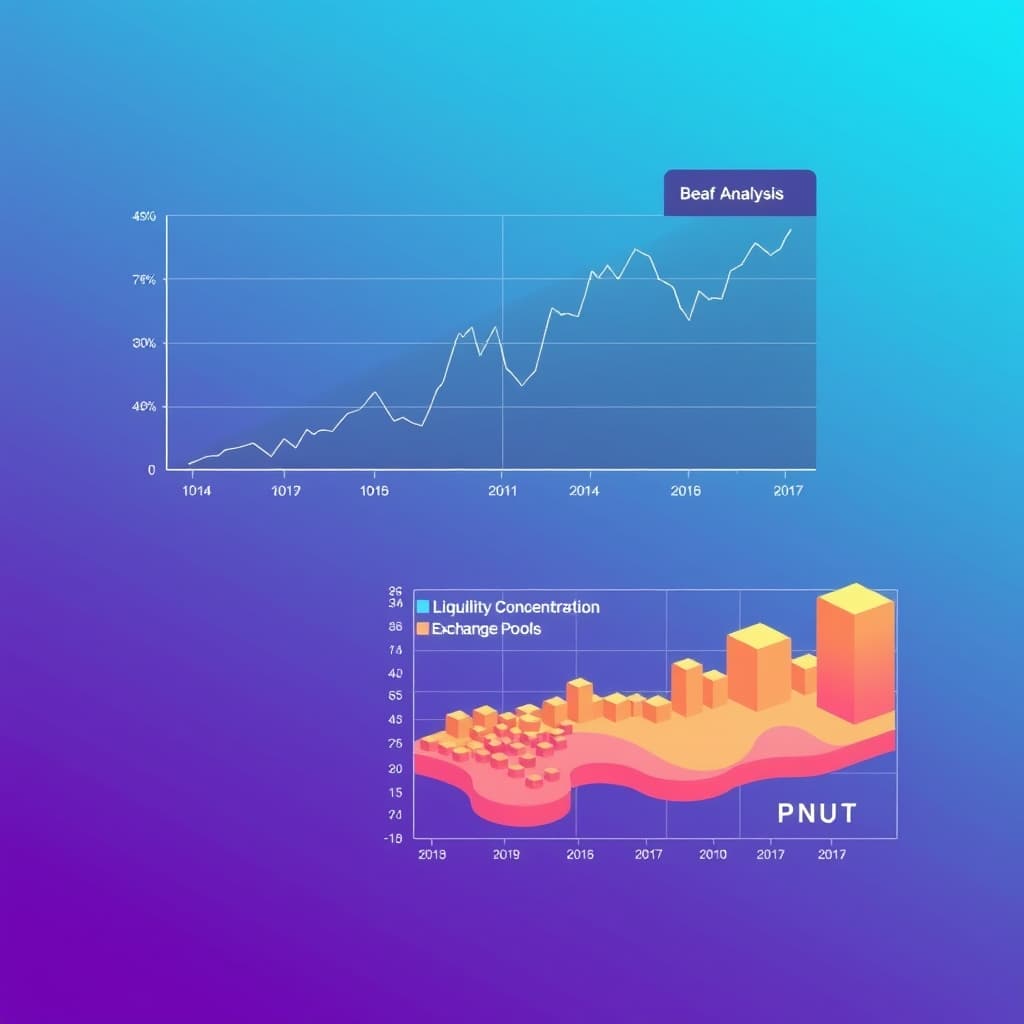
Evaluating a token without built-in utility or governance rights requires a strict focus on supply concentration. PNUT operates as a basic SPL token, meaning its economic reality is dictated entirely by holder distribution rather than protocol revenue. The Gini coefficient for PNUT indicates a top-heavy distribution typical of early-stage meme assets.
Map of Incentives: In this micro-cap environment, early accumulators (often termed "whales") win by providing fragmented liquidity at premium spreads during volatility spikes. Conversely, late-arriving retail participants lose by absorbing maximum slippage when they execute market orders during momentum-chasing phases. The structural design inherently transfers wealth from impatient liquidity takers to patient liquidity makers.
True liquidity is measured not by reported daily volume, but by the capital required to move the price by 2%. For PNUT, liquidity is heavily fragmented across automated market makers (AMMs) like Raydium and Orca.
Institutional sizing requires routing orders through aggregators that can split transactions across these pools to minimize price impact, as single-venue execution at current depths would trigger unacceptable slippage.
Occupying the #496 rank places PNUT in a precarious transition zone. It is too large to experience the exponential daily multiples of newly launched presales, yet too small to attract tier-one centralized exchange listings. The volume-to-market cap ratio serves as a critical health indicator here. A ratio falling below 0.05 signals stagnant capital velocity, meaning the asset is vulnerable to sharp drawdowns if a top-10 holder decides to liquidate.
Retail participants typically trade PNUT based on social media momentum and narrative strength. Systematic trading desks, however, monitor blockchain mempools and MEV (Maximal Extractable Value) bot activity. When retail sentiment spikes, institutional algorithms do not buy the token; they provide liquidity at the edges of the spread to harvest the increased trading fees and arbitrage price discrepancies between Raydium and secondary centralized exchanges.
The recent 2.57% daily contraction pushed PNUT to test the $0.042 support threshold. This level is not arbitrary; it represents the lower bound of concentrated liquidity positioned by sophisticated market makers earlier in the week. When the price touches $0.042, automated buying programs trigger to rebalance pools, creating a temporary floor. If this floor breaks, the next high-density bid wall does not appear until the $0.038 range.
Mini Case Study: In January 2026, a fraudulent developer impersonation triggered a massive liquidity shock for PNUT, resulting in a 54% drawdown over a 90-day period. During this event, systematic funds utilizing Orca Whirlpools for concentrated liquidity were forced to widen their spreads from 15 basis points to over 400 basis points to prevent toxic flow absorption. This historical precedent directly explains the current conservative quoting at the $0.043 level. Market makers are intentionally maintaining thinner order books to protect against sudden, sentiment-driven tail risks.
The broader Q1 2026 crypto landscape is defined by aggressive capital rotation. Speculative liquidity is highly mercenary, constantly seeking the highest possible risk-adjusted return. Currently, capital is migrating away from established mid-cap meme tokens like PNUT and flowing into heavily structured presale events. This rotation drains the bid-side liquidity from secondary markets, leaving tokens like PNUT vulnerable to slow, grinding depreciations even in the absence of negative news.
The rise of narrative-driven presales, specifically APEMARS ($APRZ), illustrates this threat perfectly. APEMARS utilizes a 23-stage presale model with built-in staking yields (63% APY) and referral mechanics, effectively locking up speculative capital that might otherwise trade tokens like PNUT.
Competitors engineered with lock-up periods and gamified pricing stages actively siphon the attention economy required to sustain PNUT's market cap.
For PNUT to break out of its current consolidation and reclaim the $0.045 upper bound, it requires a structural shift in order flow. Specifically, buy-side volume must outpace the passive sell-pressure generated by early holders taking profits. Quantitative models suggest that clearing the $0.045 resistance necessitates a 300% increase in sustained hourly volume, a metric that is highly improbable without a catalyst that bridges the gap between decentralized sub-cultures and mainstream crypto native attention.
Looking deeper into 2026, the regulatory environment poses existential questions for assets lacking utility. Under frameworks like the European Union's Markets in Crypto-Assets (MiCA) regulation, tokens functioning purely as speculative instruments face stringent listing requirements on regulated exchanges. While decentralized venues remain largely insulated, the inability to access tier-one fiat on-ramps severely caps the institutional upside for PNUT.
To invalidate my current neutral-to-bearish thesis on PNUT's market structure, I would need to see a sustained 30-day increase in unique active wallets interacting directly with the token's smart contracts, coupled with a verifiable migration of liquidity from decentralized automated market makers to tier-one centralized limit order books.
Evaluating Peanut the Squirrel at $0.043 reveals a micro-cap asset heavily constrained by fragmented liquidity and shifting macroeconomic tides. The token's survival through 2026 hinges on defending the $0.042 support zone against the gravitational pull of newer, highly structured presale competitors. Market participants must strictly monitor on-chain volume-to-market cap ratios and DEX liquidity depth, as these quantitative thresholds will dictate whether PNUT can sustain its #496 ranking or succumb to the inevitable capital rotation defining the current cycle.
How does PNUT's #496 market cap rank influence its institutional risk profile? Occupying the #496 position indicates high systemic volatility and thinner order books typical of mid-to-low cap meme tokens, requiring strict position sizing and slippage management.
What on-chain metrics are critical for tracking PNUT's market viability? Monitoring decentralized exchange liquidity pools, unique active wallet growth, and the concentration of token distribution provides the most accurate signals for sustained viability.
Loading comments...