Deep Analysis
Hyperliquid (HYPE) Institutional Analysis: Spot ETF Catalysts and Price Trajectory for 2026
April 11, 2026
...

Institutional allocators evaluating high-throughput Layer-1 networks face a persistent capital allocation risk: distinguishing between transient liquidity incentives and structural architectural advantages capable of sustaining decentralized finance (DeFi) workloads. Evaluating the Sui protocol requires separating token-driven speculation from its underlying object-centric data model, a framework that fundamentally alters state management and transaction parallelization. By analyzing the foundation's strategic capital deployments—specifically the recent integration with Splyce Finance—alongside Q2 2026 supply dynamics and parallel execution mechanics, we can quantify whether the network's infrastructure supports long-term capital retention. For foundational context on the protocol's consensus and state management mechanics, refer to the Sui Official Documentation.
The Layer-1 blockchain sector demands constant innovation to resolve the trilemma of security, scalability, and decentralization. Legacy Ethereum Virtual Machine (EVM) networks rely on account-based models, where every transaction updates a global state tree. This creates a sequential bottleneck; transactions must be processed one after another to prevent state conflicts. Sui addresses these persistent bottlenecks through a fundamentally distinct object-centric data model.
Under the Sui architecture, storage is organized around independent objects rather than user accounts. Each object contains its own state and ownership metadata. The primary mechanism here is the distinction between "owned objects" (assets controlled by a single private key) and "shared objects" (smart contracts accessible by multiple users).
The direct implication of this design is the ability to bypass global consensus for simple transfers. When a user transfers an owned object—such as sending a stablecoin or an NFT—the network does not require validators to sequence this transaction against unrelated network activity. Validators simply use Byzantine Consistent Broadcast to verify the owner's signature and confirm the transfer.
Consider a high-frequency payment application deployed on Sui. In a traditional EVM environment, a surge in NFT minting would spike gas fees and delay standard peer-to-peer transfers. On Sui, these peer-to-peer transfers operate on independent state lanes, finalizing in milliseconds regardless of congestion in other network sectors.
While simple transactions bypass traditional consensus, complex DeFi operations involving shared objects require precise sequencing. Sui manages this through a decoupled architecture utilizing the Narwhal mempool and Bullshark consensus engine. Narwhal operates as a Directed Acyclic Graph (DAG) mempool, ensuring data availability across validators before consensus is even required. Bullshark then orders these pre-validated transaction batches.
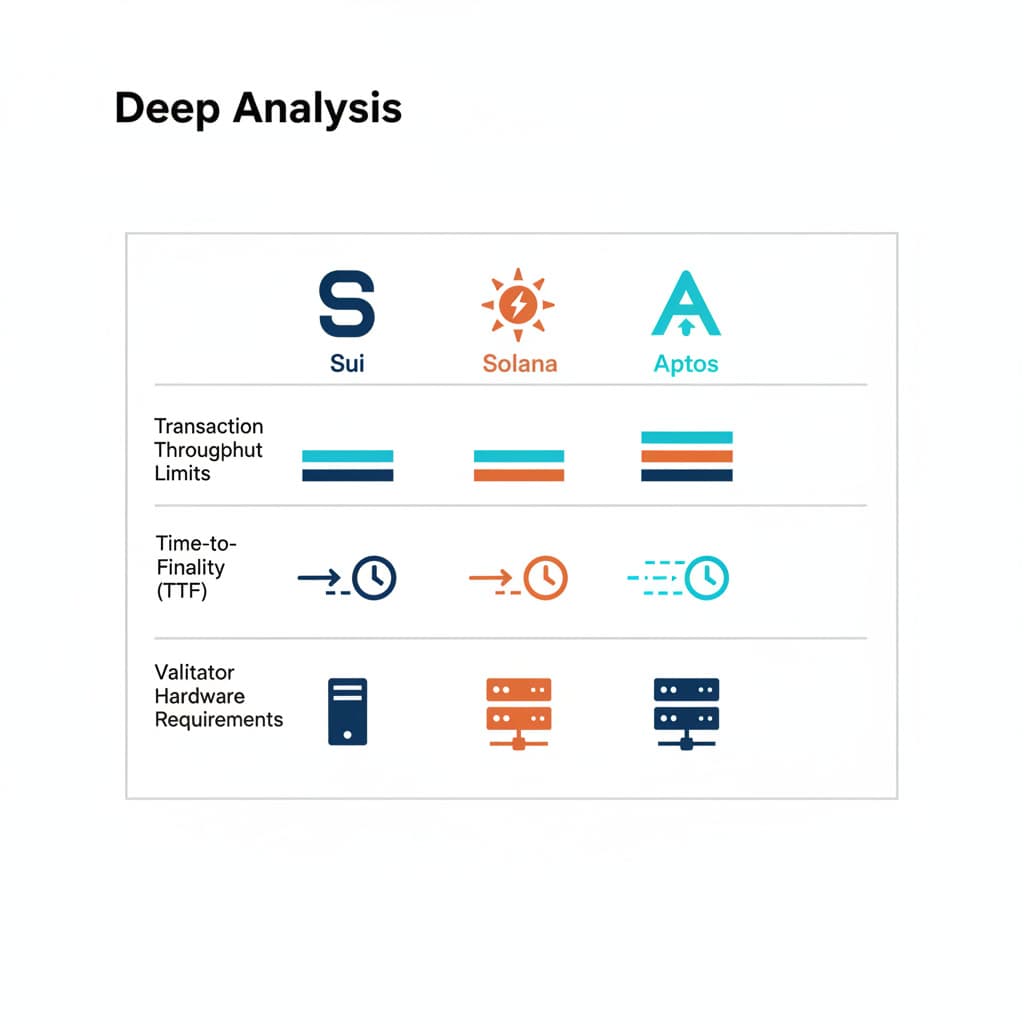
This decoupling allows validators to process independent shared-object transactions in parallel. The implication is a massive expansion in throughput capacity without sacrificing time-to-finality (TTF). Validators are limited only by their hardware capabilities (CPU cores and network bandwidth) rather than protocol-level sequential bottlenecks.
Infrastructure alone rarely commands a premium valuation without a thriving application layer. The recent strategic investment by the Sui Foundation into Splyce Finance represents a calculated move to bootstrap decentralized finance total value locked (TVL) during the critical Q2 2026 window.
The mechanism driving this ecosystem growth is direct foundation-level liquidity deployment. Rather than relying purely on organic capital migration, the Sui Foundation acts as an anchor liquidity provider. By deploying capital directly into Splyce Finance's automated market makers (AMMs) and lending pools, the foundation subsidizes the initial yield required to attract cross-chain capital.
Map of Incentives:The implication of this targeted injection is a rapid acceleration in network TVL. A mini case study of this dynamic can be observed in the immediate aftermath of the Splyce Finance announcement. As the foundation's capital hits the pools, the depth of SUI/USDC and SUI/wETH pairs increases. This depth reduces slippage for large institutional orders, which in turn attracts algorithmic traders and arbitrageurs.
The second-order effect is the generation of organic fee revenue for validators. As Splyce Finance processes higher volumes, the velocity of the SUI token increases, creating a sustainable yield loop for network stakers that eventually replaces the need for foundation subsidies.
Valuation models for Layer-1 assets require a precise understanding of supply inflation against network demand. As of April 11, 2026, SUI trades at an inflection point that warrants close institutional scrutiny.
The SUI token operates with a hard-capped maximum supply of 10 billion tokens. A critical metric for assessing immediate price pressure is the circulating supply relative to the staking ratio. When a high percentage of the circulating supply is locked in validator staking pools, the effective float available for spot market liquidation decreases.
Validators and delegators earn staking rewards derived from transaction fees and network subsidies. If the staking APY outpaces the rate of token unlocks from early investors and team allocations, the network establishes a natural price floor. Conversely, if network activity drops, the staking yield compresses, prompting delegators to unstake and sell, exacerbating downward volatility.
The recent 1.99% upward valuation shift to $0.948 must be contextualized within the broader Q2 2026 altcoin rotation. With Bitcoin exhibiting bearish signals on prediction markets like Polymarket for the remainder of 2026, capital is actively seeking high-beta opportunities in ecosystems demonstrating tangible fundamental growth.
This specific price action reflects the market pricing in the Splyce Finance integration. Institutional desks are recognizing that the foundation's liquidity injection will lock a portion of the circulating supply into DeFi protocols, effectively reducing sell-side depth. The $0.926 support level established over the past 24 hours suggests strong limit-order demand from allocators positioning for a breakout above the $1.00 threshold.
Sui does not operate in a vacuum. It competes directly for developer mindshare and cross-chain liquidity against established parallelized networks like Solana and its Move-language sibling, Aptos.
The underlying mechanism driving developer retention on Sui is the specific dialect of the Move programming language it employs. Originally developed by Meta, Move is fundamentally designed around digital scarcity and asset safety. Sui's implementation, known as Sui Move, treats smart contracts as modules that operate on objects.
This design inherently prevents common EVM vulnerabilities, such as reentrancy attacks, because the runtime enforces strict resource typing. The implication for institutional builders is a drastically reduced auditing surface area. A decentralized exchange built on Sui Move requires fewer security overheads compared to a Solidity equivalent. Consequently, developer onboarding metrics have shown sustained growth, as traditional Web2 engineers find the object-oriented structure of Sui Move more intuitive than account-based paradigms.
Capital efficiency dictates that liquidity will flow to the path of least resistance. Sui's competitive footprint relies heavily on its bridging infrastructure. Integrations with cross-chain messaging protocols like Wormhole allow seamless capital migration from Ethereum and Solana.
When the Sui Foundation subsidizes yields on platforms like Splyce Finance, it is these bridges that facilitate the influx of wrapped assets (wETH, wBTC). Monitoring the net inflow/outflow ratios across these bridges provides a leading indicator of network health. A sustained positive net flow indicates that Sui is successfully capturing market share from legacy L1s, rather than just cannibalizing its own internal liquidity.
Looking beyond immediate market cycles, the long-term viability of the Sui protocol hinges on its ability to integrate with the broader global financial system. The 2026-2030 horizon requires a pivot from purely crypto-native use cases to institutional-grade asset management.
The object-centric model is uniquely suited for Real-World Asset (RWA) tokenization. In traditional finance, assets like corporate bonds, real estate deeds, or treasury bills are non-fungible by nature; they have specific maturity dates, interest rates, and legal identifiers.
Mapping these instruments onto an EVM account model requires complex smart contract logic to track individual asset states. On Sui, each tokenized treasury bill can be minted as a distinct on-chain object with its own embedded metadata. This mechanism allows financial institutions to manage regulatory compliance directly at the asset level. If a specific tokenized bond must be frozen due to a compliance breach, the issuer can target that specific object without disrupting the broader smart contract ecosystem.
As we project network utilization into the late 2020s, the convergence of DeFi expansion and TradFi integration will test the protocol's theoretical limits. The current testnet throughput of nearly 300,000 TPS provides a significant buffer. However, the true test will be state bloat management.
Because objects can be deleted or archived when no longer needed, Sui possesses a structural advantage in managing the long-term storage costs that plague older networks. Institutional adoption targets for 2026 emphasize the deployment of enterprise-grade validator infrastructure to support this anticipated data load, ensuring that TTF remains sub-second even during periods of extreme global market volatility.
Sui presents a compelling infrastructure layer capable of managing high-frequency decentralized applications without sacrificing finality speed. The architectural shift away from account-based bottlenecks toward an object-centric execution environment provides a verifiable technical moat. The critical metric to monitor remains the sustained growth of DeFi liquidity following strategic foundation injections like the Splyce Finance initiative. If the network successfully converts subsidized TVL into organic, fee-generating volume, the current valuation metrics will likely re-rate to reflect its position as a primary hub for institutional decentralized finance.
How does Sui's object-centric architecture facilitate parallel execution? Unlike traditional account-based models that mandate sequential processing to prevent state conflicts, Sui organizes data into independent objects. Transactions targeting discrete objects bypass global consensus, allowing the network to process them simultaneously and drastically reducing latency.
What is the strategic significance of the Sui Foundation's investment in Splyce Finance? The capital injection acts as a primary liquidity bootstrap for the network's decentralized finance sector. By aggressively funding native yield protocols, the foundation aims to attract cross-chain capital, directly increasing TVL and driving underlying token utility.
Loading comments...