Deep Analysis
Bittensor (TAO) Institutional Analysis: Subnet Economics and the $400 Breakout Target
April 08, 2026
...


Retail market participants consistently misprice existential risk, treating the $1.35 XRP consolidation as a standard technical pause. The reality is far more calculated: institutional capital is actively front-running a structural event—the impending post-quantum cryptography (PQC) migration. Drawing on over 15 years of experience in quantitative modeling and regulatory policy research, my framework for evaluating digital asset infrastructure strictly separates speculative retail beta from institutional-grade utility. The Bank for International Settlements (BIS) has already signaled through its Project Leap initiative that legacy public-key cryptography is living on borrowed time. We are currently observing a rare macroeconomic convergence. The XRP Ledger (XRPL) is systematically integrating NIST-approved quantum-resistant standards on its developer networks, precisely as severe geopolitical stress and surging energy markets force a global liquidity reshuffle. Evaluating the asset at its current threshold requires decoupling it from standard market volatility and analyzing its mechanical evolution as a future-proofed global settlement layer.
The timeline for quantum computers to break classical encryption is compressing rapidly. Asset managers and researchers now estimate that a machine capable of executing Shor’s algorithm at scale could materialize by 2029. In response, the U.S. National Institute of Standards and Technology (NIST) finalized its post-quantum encryption standards, specifically FIPS 203, 204, and 205, in August 2024. Recognizing this existential threat, XRPL developers have initiated the integration of FIPS 204, known as the Module-Lattice-Based Digital Signature Algorithm (ML-DSA), into the AlphaNet test environment.
This upgrade replaces traditional elliptic curve cryptography with lattice-based mathematical structures that theoretically withstand decryption attempts by quantum hardware. Accounts holding billions in XRP that have never exposed their public keys on-chain remain natively secure. For active institutional wallets, the network is testing hybrid cryptographic models and on-ledger key rotation, allowing validators to upgrade consensus mechanisms without exposing the live network to security gaps.
Transitioning to quantum resistance introduces strict operational trade-offs. The legacy secp256k1 standard produces highly efficient signatures, whereas ML-DSA generates proofs of approximately 2,420 bytes. This exponential increase in data load directly impacts node storage, bandwidth requirements, and potential settlement latency. Network engineers must optimize these heavier cryptographic primitives to maintain the ledger's standard three-to-five-second settlement finality.
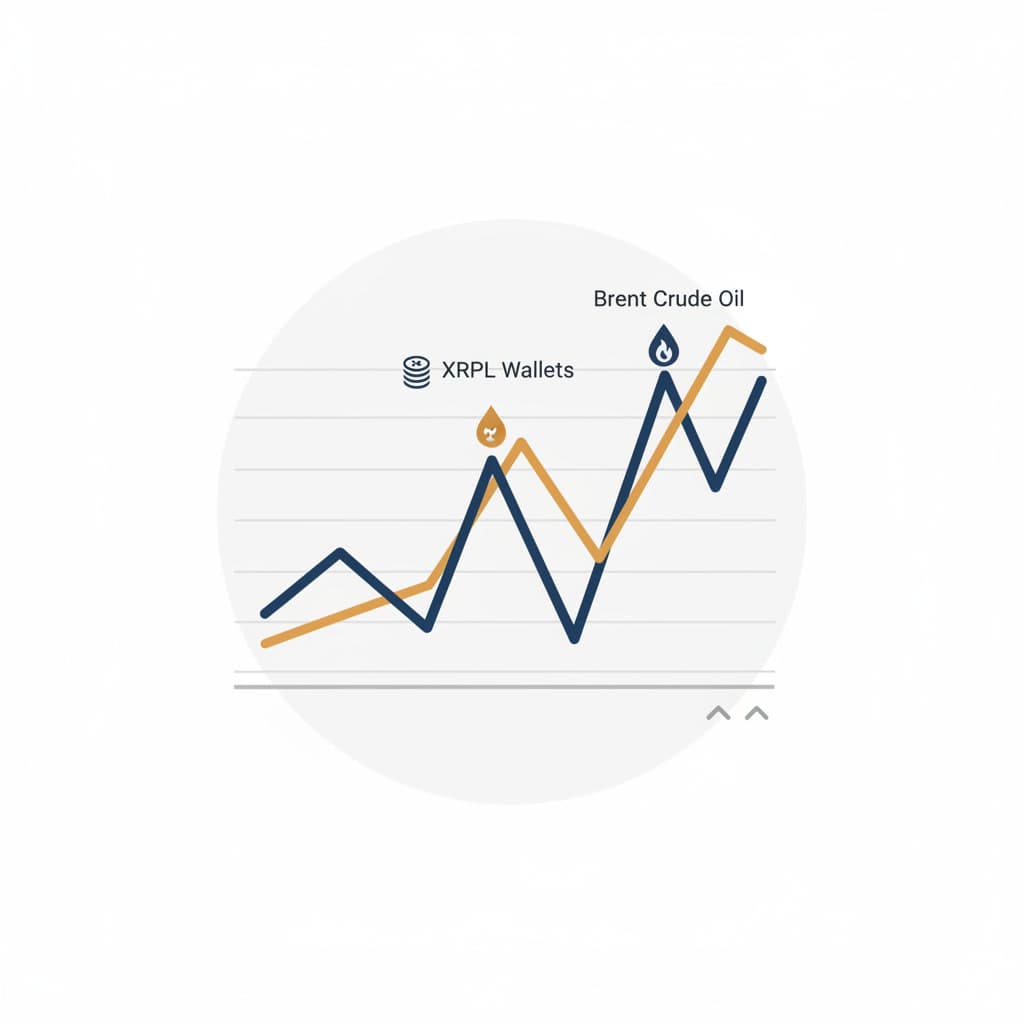
The current $1.35 valuation cannot be analyzed in a vacuum; it is heavily suppressed by severe macroeconomic friction. The escalation of Middle Eastern conflicts, specifically the US-Iran geopolitical tension, has triggered a massive rally in Brent crude oil prices. Historically, energy shocks force broader risk-off capital allocations across all speculative markets. Digital assets, including Bitcoin and XRP, face immediate downward pricing pressure as institutional liquidity retreats to traditional safe havens like sovereign bonds and gold.
Despite a localized 5% daily surge earlier in the month, the asset has faced significant resistance breaking out of its current range, reflecting the broader market's hesitation to deploy capital during energy-driven inflationary spikes.
Case Study: Liquidity Routing During the Q2 2026 Energy Shock During the peak of the April 2026 oil price surge, traditional financial rails experienced heightened friction due to correspondent banking delays and risk-averse counterparty behavior. While retail investors liquidated digital asset positions, on-chain metrics revealed a localized anomaly: large-tier wallets accelerated their accumulation.
Entities holding substantial capital began absorbing over 11 million XRP daily. This behavior mirrors institutional actions during the 2022 rate hike cycle, where utility-driven assets were accumulated over pure store-of-value tokens to facilitate immediate cross-border settlement. The divergence between stagnant spot prices and aggressive large-tier buying indicates that sophisticated actors are utilizing the asset as a bridging mechanism to bypass geopolitical friction in legacy banking corridors.
The stabilization at $1.35 is fundamentally supported by an ongoing restructuring of token distribution. Network analysis indicates that a significant percentage of the circulating supply is migrating into institutional custody solutions. The daily absorption of millions of tokens by whale accounts mathematically limits downside volatility, creating a hard floor against macroeconomic shocks. This accumulation is not driven by retail speculation but by entities requiring deep liquidity pools to execute high-volume cross-border transfers.
Network utility remains the primary driver of institutional interest. As global trade routes face disruption and currency volatility spikes, the demand for instant, low-
Loading comments...