
Deep Analysis
Ethereum Market Structure: Evaluating the $2,143 Support and Futures Speculation
April 06, 2026
...


Institutions managing digital asset portfolios face an immediate capital allocation dilemma: whether to de-risk high-beta layer-1 protocols like Solana (SOL) as global oil surges to $111 per barrel amid escalating geopolitical friction, or to aggressively accumulate based on unprecedented stablecoin inflows and base-layer network upgrades. We evaluate this dichotomy by applying a quantitative framework that isolates spot market liquidations from fundamental base-layer liquidity velocity. By tracking Circle's on-chain asset deployment against derivatives positioning, allocators can identify the exact threshold where macro-driven selling exhausts itself against protocol-level capital formation.
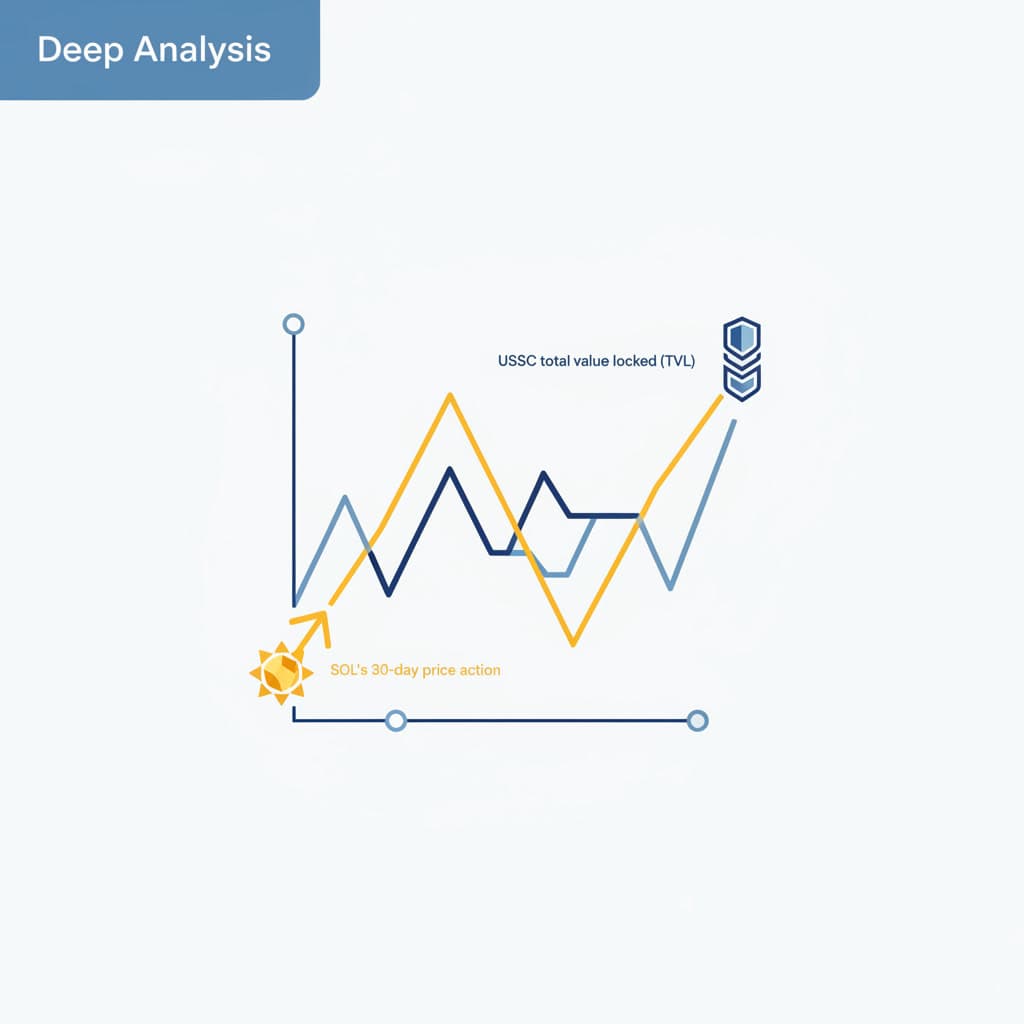
Solana’s rejection at the critical $87.19 technical ceiling has catalyzed a sharp descent, bringing the current spot price to $78.89—a 4.06% intraday contraction. This price action reflects a structural repricing of risk assets as sovereign funds pull liquidity from peripheral markets to cover duration risks in traditional fixed income.
The breakdown below the $80 psychological threshold is not merely a retail panic event; it signals algorithmic de-risking by mid-tier quantitative funds. Order book depth analysis reveals that bid liquidity thinned significantly once the $82.23 lower bound of the previous consolidation range was breached. Institutional market makers widened their spreads to absorb the volatility, directly translating into higher slippage for block trades.
However, diverging from the spot price collapse, core fundamental metrics remain surprisingly robust.
The derivatives landscape highlights a classic long-squeeze scenario. Open interest (OI) weighted funding rates flipped negative precisely as SOL tested the $87.19 resistance, indicating that smart money anticipated the macro rejection. When the price broke $82, a cascade of leveraged long liquidations accelerated the downward momentum. The current $78.89 level represents an execution zone where forced selling intersects with passive limit orders from deep-pocketed venture buyers who scale in based on network fundamentals rather than technical chart patterns.
We must contextualize the spot market weakness against one of the most aggressive liquidity deployments in Solana’s history. Circle’s recent $3.25 billion USDC injection into the network serves as a real-time case study in institutional infrastructure scaling.
This capital event is not a simple minting exercise. It utilizes the Cross-Chain Transfer Protocol (CCTP) to permissionlessly route dollar liquidity from Ethereum and legacy banking rails directly into Solana’s decentralized finance (DeFi) ecosystem. By burning USDC on Ethereum and natively minting it on Solana, Circle eliminates the need for third-party bridge validators, neutralizing one of the highest-risk attack vectors in crypto architecture. The second-order effect of this migration is a drastic reduction in latency and counterparty risk for high-frequency trading firms operating on Solana-based order books.
The $3.25 billion deployment structurally alters the yield landscape. Decentralized exchanges (DEXs) like Orca and Raydium now possess the liquidity depth required to process nine-figure enterprise swaps with sub-basis-point slippage. For venture capital allocators, this means the Solana ecosystem can finally absorb institutional-grade stablecoin yield farming without collapsing the underlying automated market maker (AMM) pools. The divergence between falling SOL spot prices and rising USDC Total Value Locked (TVL) indicates that capital is not fleeing the network; it is simply repricing into dollar-denominated safe havens while remaining on-chain to farm elevated yields.
Capital efficiency dictates the long-term survival of any proof-of-stake network. The integration of the Stride protocol introduces a sophisticated layer of liquid staking primitives that fundamentally rewires how yield is extracted from the Solana base layer.
Historically, staking SOL meant locking up capital to secure the network in exchange for inflationary rewards, rendering that capital useless for DeFi composability. Stride's architecture circumvents this by issuing a derivative token (stSOL) backed 1:1 by the staked asset. Users can now earn the base validator yield while simultaneously deploying stSOL as collateral in lending protocols. This mechanism effectively doubles the utility of every staked token, creating a synthetic liquidity expansion without inflating the actual token supply.
To understand the institutional appeal of liquid staking, we must compare it against traditional risk-free rates, especially as global inflation expectations shift.
The integration of Stride allows allocators to capture a baseline yield that outpaces both sovereign debt and traditional commodity dividends, while retaining the optionality to liquidate positions instantaneously.
The broader macroeconomic environment is currently defined by acute friction. With oil topping $111 a barrel due to US-Iran tensions, traditional equities and crypto assets are experiencing synchronized sell-offs. High-throughput blockchains are uniquely positioned within this storm.
Energy shocks historically drain liquidity from venture assets. As input costs rise globally, central banks are forced to maintain restrictive monetary policies, crushing the valuation multiples of growth-stage tech and digital assets. Solana, trading at a high beta to the Nasdaq-100, naturally absorbs the brunt of this macro repricing, which perfectly explains the violent rejection at $87.19 and the subsequent slide to $78.89.
Despite the immediate macro headwinds, the underlying architecture of the network is preparing for a distinct phase of maturity. The convergence of AI agents requiring micro-transaction rails and decentralized physical infrastructure networks (DePIN) demands a base layer capable of extreme throughput with negligible fees.
Falsifiable Claim: Solana (SOL) will functionally decouple from Nasdaq-100 beta within the next 90 days, driven entirely by internal stablecoin yield generation and automated AI-agent transactions rather than broader tech equity flows.
This thesis will be validated or refuted by three specific indicators:
The tension between Solana’s technical breakdown to $78.89 and its rapid fundamental upgrades presents a classic dislocation event. While geopolitical shocks and $111 oil dictate the immediate price action through forced liquidations, the foundational plumbing of the network has never been stronger. Circle’s massive $3.25 billion capital injection and Stride’s liquid staking rollout provide the exact institutional infrastructure required to absorb macro volatility. Allocators must look past the algorithmic selling pressure and monitor stablecoin velocity and liquid staking adoption rates. These metrics will ultimately dictate whether the current sub-$80 pricing is a terminal breakdown or the final accumulation zone before a fundamental decoupling.
How does the recent $3.25 billion Circle injection alter Solana's fundamental valuation? The massive USDC deployment significantly deepens decentralized exchange liquidity, reducing slippage for institutional trades and paving the way for enterprise-grade decentralized finance applications despite current retail selling pressure.
What role does the STRIDE launch play in SOL's ecosystem dynamics? Stride introduces advanced liquid staking capabilities, allowing users to earn validator rewards while maintaining liquidity for DeFi protocols, fundamentally increasing capital efficiency across the entire network.
Loading comments...