
Petrodollars Meet Hollywood: Inside the $81 Billion Sovereign Entertainment Consolidation
For institutional investors and media executives, the most urgent risk in the current market is mispricing the geopolitical premium now embedded in legacy entertainment assets. As traditional debt markets choke on sustained capital costs, Wall Street has quietly retreated from funding mega-mergers. Stepping into this vacuum is a tidal wave of Gulf state liquidity, fundamentally transforming American studios from purely commercial enterprises into strategic national assets for foreign powers. Drawing on over 15 years of experience structuring cross-border M&A and media acquisitions, my framework evaluates this sovereign entertainment consolidation not as a temporary anomaly, but as a permanent restructuring of Hollywood's capital stack. We will dissect the mechanics of these equity injections, the regulatory workarounds deployed to bypass CFIUS and the FCC, and the second-order effects this shift imposes on global media governance.
The Mechanics of Petrodollar Liquidity in Modern M&A
Bypassing Traditional Debt Markets
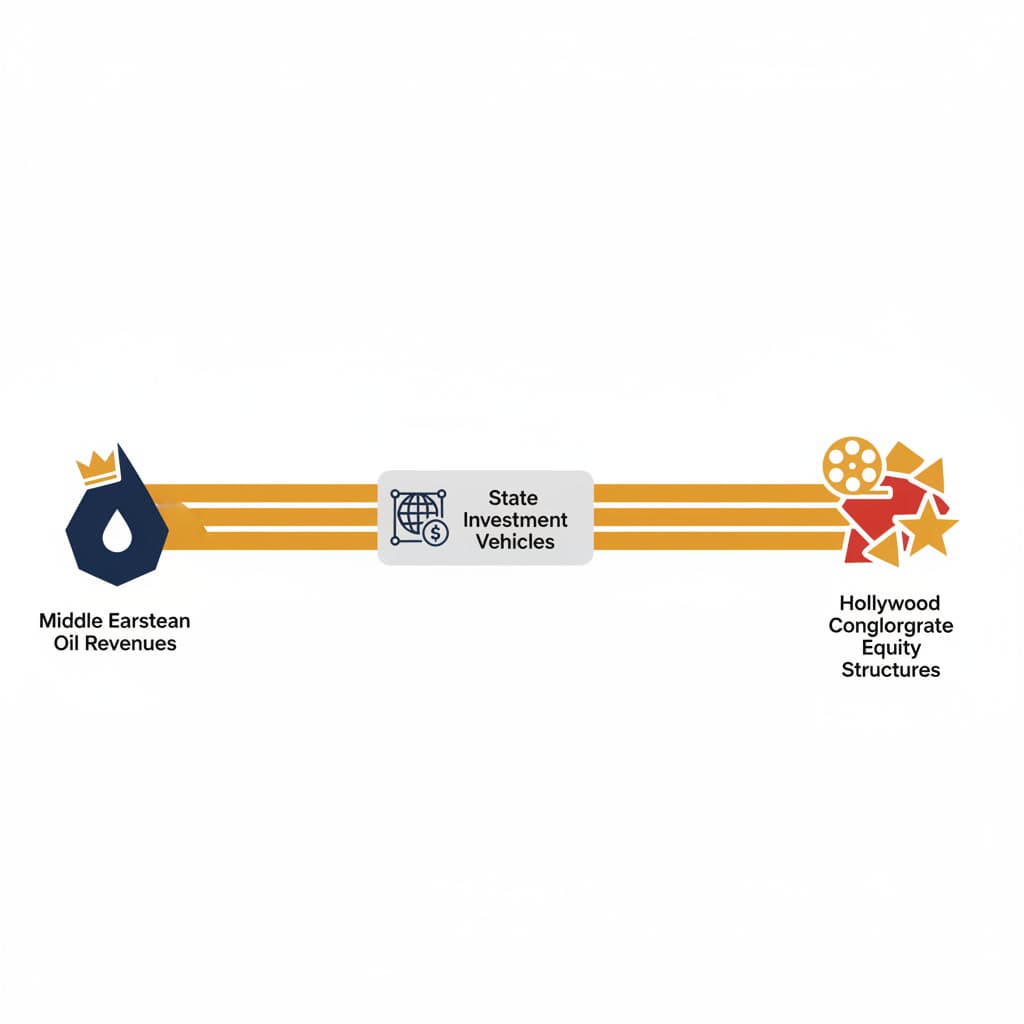
The fundamental mechanism driving the current wave of media consolidation is the substitution of syndicated debt with sovereign equity. Historically, a transaction on the scale of an $81 billion takeover would rely heavily on leveraged loans and high-yield bond issuances. Today, the arithmetic of debt financing is punitive. Acquirers facing mature, low-growth linear television assets cannot service the interest burdens required by traditional Wall Street lenders.
By injecting direct, unleveraged capital, sovereign wealth funds provide the necessary liquidity to close mega-deals without destroying the target company's balance sheet. This structural shift alters the cost of capital entirely. State-backed funds operate with multi-decade time horizons, prioritizing long-term asset accumulation over the quarterly yield demands that constrain private equity.
Structuring Cross-Border Equity Injections
The deployment of this capital requires precise architectural engineering to avoid triggering immediate regulatory blockades. Funds do not simply buy voting shares on the open market; they establish complex joint ventures and special purpose vehicles.
A critical mini case study is RedBird IMI, a joint venture between New York's RedBird Capital Partners and Abu Dhabi's International Media Investments (IMI). When RedBird IMI acquired the UK production giant All3Media for £1.15 billion in 2024, it served as a proof of concept. The deal proved that Middle Eastern capital could successfully absorb premium Western production houses by partnering with established domestic private equity operators, effectively laundering the geopolitical optics through a recognized American intermediary. This exact blueprint is now being scaled up for tier-one studio acquisitions.
Anatomy of the $81 Billion Paramount-Warner Bros. Discovery Deal
Valuation Arbitrage in the Streaming Era
The proposed merger between Paramount Skydance and Warner Bros. Discovery, carrying an enterprise value of $110 billion and an equity valuation of $81 billion, is a masterclass in valuation arbitrage. Warner Bros. Discovery’s stock suffered severe compression throughout the streaming wars, burdened by post-merger debt and declining linear ad revenues. Paramount, backed by David Ellison and RedBird Capital, identified a vulnerability: WBD possessed irreplaceable intellectual property—from HBO to DC Comics—but lacked the balance sheet flexibility to exploit it.
The implication here is severe for retail shareholders. Legacy media valuations have been driven so low that they are now prime targets for privatization or quasi-privatization by actors who are immune to public market volatility.
The Silent Partners Funding the Takeover
To execute this takeover, Paramount Skydance secured nearly $24 billion in signed equity commitments from three primary Gulf entities.
- Winners: Legacy Studios secure survival capital without crippling debt loads; Sovereign Wealth Funds acquire premium cultural assets at depressed valuations with non-correlated revenue streams.
- Losers: Traditional Wall Street Lenders are cut out of the financing stack for mega-mergers; Retail Shareholders suffer equity dilution while lacking the board-level access and preferential terms granted to anchor state investors.
Strategic Diversification Beyond Crude Oil
Soft Power Acquisition and Regional Megaprojects
The influx of capital into Western entertainment is not a vanity play; it is a calculated mechanism for soft power acquisition. Gulf states are rapidly transitioning their domestic economies to attract global tourism, talent, and foreign direct investment. By owning the foundational infrastructure of global storytelling, these nations can indirectly shape cultural narratives and integrate Western media properties into their own regional megaprojects.
When a sovereign fund holds a multi-billion dollar stake in a combined Paramount-WBD entity, the second-order effect is the seamless licensing of premium IP for theme parks, esports arenas, and entertainment districts in Riyadh, Doha, and Abu Dhabi.
Hedging Against Global Energy Transitions
Simultaneously, this consolidation acts as a macroeconomic hedge. The global energy transition threatens the terminal value of hydrocarbon revenues. Sovereign wealth funds are tasked with replacing oil yields with sustainable, high-cash-flow alternatives. Media conglomerates, despite their current linear TV headwinds, possess massive libraries of copyright-protected assets that generate perpetual licensing revenue. By trading crude oil liquidity for Hollywood intellectual property, Gulf states are effectively converting finite physical commodities into infinite digital assets.
Navigating Regulatory Scrutiny and CFIUS Hurdles
National Security and Media Ownership Limits
The most formidable constraints on sovereign entertainment consolidation are the regulatory frameworks governing national security and broadcast infrastructure. In the United States, the Federal Communications Commission (FCC) strictly limits foreign ownership of broadcast licenses to 25% indirect control, absent a specific public interest waiver. Concurrently, the Committee on Foreign Investment in the United States (CFIUS) aggressively audits foreign transactions that could compromise national security—a definition that increasingly includes data privacy and editorial control over major news organizations like CNN and CBS News.
Structuring Non-Voting Stake Workarounds
To bypass these hurdles, sovereign funds utilize structured non-voting stake workarounds. The $24 billion Gulf capital stack in the Paramount-WBD deal is deliberately fragmented. By splitting the investment across the PIF, QIA, and L'imad Holding, no single foreign entity breaches the ownership thresholds that would trigger an automatic CFIUS intervention or violate FCC mandates.
The implication of this structure is profound: Gulf states are willing to forgo formal voting power in exchange for preferential economic returns and unspoken strategic influence, knowing that a company reliant on your capital rarely acts against your interests.
The Next Wave of Legacy Studio Targets
Gaming and Interactive Media Synergies
Looking toward the 2026-2030 cycle, the consolidation strategy will aggressively pivot from linear film and television into interactive media. Sovereign funds recognize that the future of entertainment IP is interactive. Saudi Arabia’s Savvy Games Group has already deployed billions into the esports and gaming sector. The next logical mechanism is the merging of legacy film studios with tier-one video game publishers. Companies possessing massive interactive ecosystems are prime targets for the next wave of petrodollar-backed M&A, as acquirers look to build interoperable cinematic and gaming universes under a single corporate umbrella.
Consolidation Forecast for the 2026-2030 Cycle
The Paramount-WBD transaction is merely the catalyst. As we move deeper into 2026, mid-tier studios and independent production houses will face a binary choice: accept sovereign capital or be crushed by the scale of those who do. The cost of content production and platform maintenance has rendered the standalone media company obsolete. Expect to see highly structured, state-backed private equity vehicles aggressively targeting remaining independent IP libraries, permanently altering the competitive landscape of Western media.
Final Verdict on Sovereign Media Governance
Sovereign capital ensures the survival of legacy media, but it permanently alters its governance structure. The era of the pure-play, domestically financed American entertainment conglomerate has ended. While regulatory bodies will heavily scrutinize the European Commission antitrust reviews and FCC broadcast license transfers throughout late 2026, the financial reality remains absolute. Hollywood's balance sheets require a lender of last resort, and the Gulf states are currently the only entities capable of writing the check.
FAQ
How does sovereign wealth fund involvement change media governance? By acting as anchor investors, these funds often secure board observer seats or indirect influence over strategic capital allocation, prioritizing long-term yield over quarterly earnings cycles.
Will the FCC or CFIUS block foreign state investments in US entertainment conglomerates? Regulatory bodies heavily scrutinize foreign control over broadcasting licenses. Deals are typically structured with passive, non-voting equity to satisfy CFIUS requirements while delivering the necessary liquidity.
Sources
Loading comments...
Related
View all →