Crypto
Wall Street Meets Blockchain: Inside the SEC Approval of Nasdaq Tokenized Securities
March 19, 2026
...

In March 2026, OKX deployed its Agentic Wallet as the execution layer for Onchain OS, allowing artificial intelligence models to sign transactions across 20 blockchains without human prompting. This framework relies on Trusted Execution Environments (TEEs) rather than manual multi-sig approvals to secure private keys. Evaluating this from a quantitative infrastructure perspective, this deployment shifts the paradigm from simple account abstraction to true machine autonomy, systematically removing the latency and operational bottlenecks of human-in-the-loop settlement.
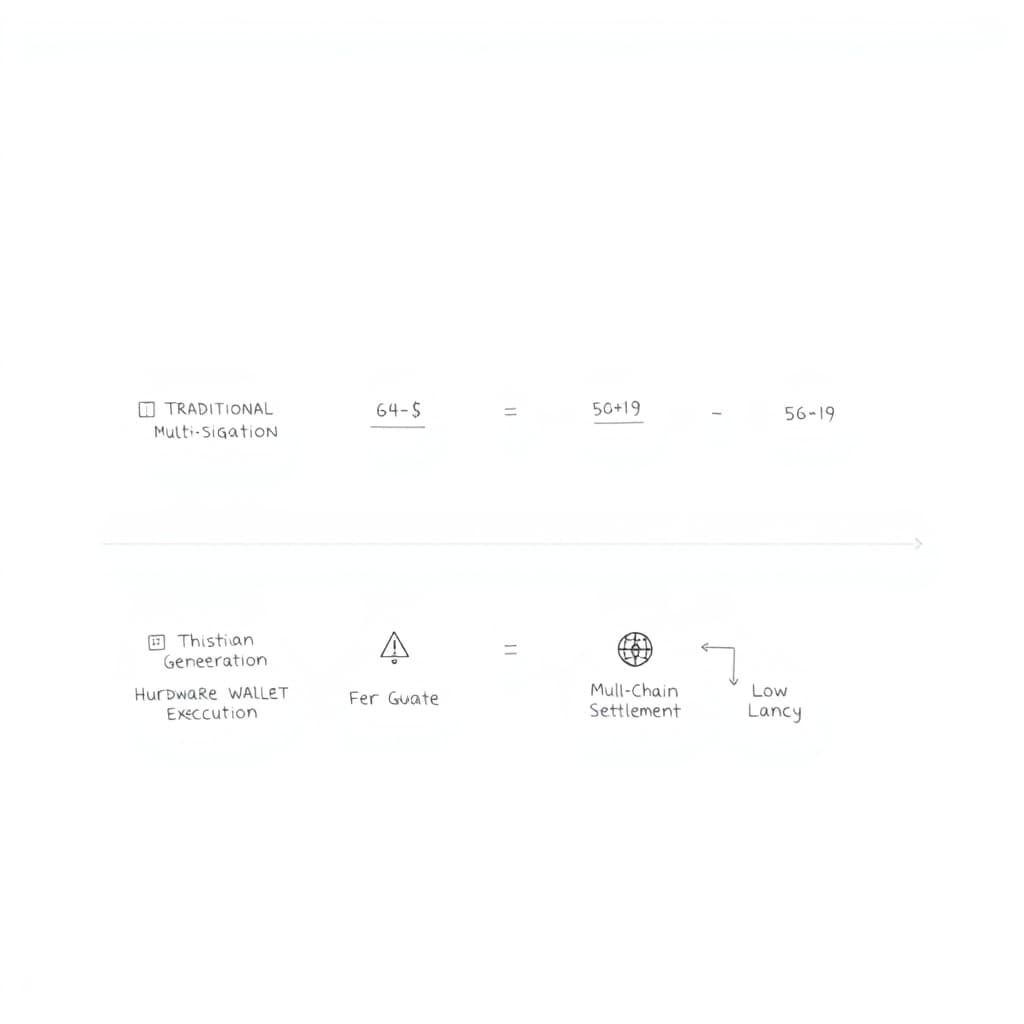
Traditional wallets rely on Externally Owned Accounts (EOAs) where the private key is a single point of failure exposed to the user interface. The OKX architecture isolates private keys within a Trusted Execution Environment (TEE). The AI model never accesses the key directly; it submits intents via a Model Context Protocol (MCP) or Command Line Interface (CLI).
This fundamentally changes how quantitative funds secure their operations. Instead of securing the key, the objective shifts to securing the prompt and the permission boundaries. If a language model is compromised or hallucinates a malicious trade, the TEE's pre-execution simulation grades the risk. Critical risk classifications trigger an immediate block at the hardware enclave level, ensuring the vulnerability does not result in drained funds.
By leveraging Account Abstraction (ERC-4337), the wallet itself functions as a programmable smart contract. This allows the agent to batch transactions, handle gas abstraction, and execute multi-step logic in a single atomic block.
Algorithms no longer need to calculate precise native gas token balances across 20 different chains before routing a trade. A cross-chain arbitrage bot detects a discrepancy between Solana and an EVM layer, abstracts the gas fees into USDC, and settles the discrepancy instantly without waiting for a human to bridge gas tokens.
OKX's Onchain OS enforces strict boundary conditions. AI agents submit plain-language instructions which are parsed into transaction payloads. Before execution, a deterministic simulation engine evaluates the state change.
Quants deploy models with hardcoded risk parameters, such as maximum slippage, whitelisted contract addresses, and daily drawdown limits. A momentum-trading agent is given an allowance of 50 ETH. The permission system ensures that even if the AI generates an intent to swap 100 ETH, the transaction fails at the simulation layer, protecting the core treasury.
Human-centric wallets wait for clicks and browser extension approvals. Agentic wallets bypass the UI entirely, communicating directly with RPC nodes via API. Execution latency drops from seconds—limited by human reaction time—to milliseconds.
OKX's infrastructure currently handles over 1.2 billion daily API calls. When an AI detects a yield farming opportunity on a new decentralized exchange, it generates the intent, simulates the outcome, and signs the transaction in sub-100ms. This captures the alpha before retail UI users even load the webpage.
Autonomous agentic wallets continuously scan 500+ DEXs connected through the Onchain OS. They evaluate lending rates, liquidity pool depths, and staking rewards in real time. Capital efficiency reaches theoretical maximums as idle assets are dynamically routed to the highest-yielding, risk-adjusted protocols without manual portfolio rebalancing.
During a sudden spike in stablecoin borrow rates on Aave, an agentic wallet instantly withdraws USDC from a lower-yielding protocol and supplies it to Aave. It captures the premium yield for the duration of the spike, then reverts the position once rates normalize.
By integrating real-time market data feeds, the AI executes complex hedging strategies. If volatility spikes, the agent autonomously shorts a correlated asset or buys options. Downside protection becomes proactive rather than reactive.
A portfolio heavily weighted in ETH detects a macroeconomic shock via natural language news parsing. The agentic wallet immediately executes a delta-neutral hedge by shorting ETH perps on a decentralized derivative platform, entirely bypassing the human portfolio manager's sleep schedule.
Map of Incentives: The Shift to Agentic ExecutionWhen an AI model executes a trade that results in market manipulation or interacts with a sanctioned entity, the blockchain only records the smart contract interaction. Regulators face a severe attribution problem. Liability could fall on the AI developer, the wallet provider, or the user who deployed the agent.
The SEC and ESMA currently lack frameworks for non-human intent generation. If an autonomous agent accidentally executes a wash trade to optimize a yield strategy, determining scienter (intent to deceive) becomes legally ambiguous.
To mitigate legal risks, developers embed compliance oracles and behavioral guardrails directly into the agent's prompt architecture and the wallet's TEE. The market requires the implementation of "Compliance-as-a-Service" for AI agents, where transactions are simulated against a database of regulatory constraints before execution.
A transaction generated by an agent passes the financial risk simulation but fails the compliance simulation if the counterparty address is flagged by blockchain analytics firms, resulting in an automated block.
Future iterations move beyond single-agent architectures to multi-agent swarms. Different AI models specialize in distinct tasks—one analyzing sentiment, another optimizing gas, and a third executing the trade. DeFi protocols will be entirely populated by interacting machine intelligences, negotiating block space and liquidity dynamically.
By 2028, cross-chain swarms will emerge where an agent on Ethereum negotiates a flash loan while simultaneously coordinating with an agent on Solana to execute an arbitrage, settling the profit back to a cold storage vault.
Traditional finance institutions require enterprise-grade custody. The integration of TEEs with Multi-Party Computation (MPC) and Account Abstraction provides a bridge. Asset managers deploy proprietary LLMs to manage client funds on-chain, utilizing agentic wallets as the secure execution environment.
Institutional desks deploy AI agents to manage tokenized bond portfolios, using
Loading comments...