Crypto
The Sovereign Credibility Hedge: Decoding the $1 Billion Institutional Flight to Bitcoin
March 17, 2026
...


Every trading day, roughly $2.5 trillion in US equity volume is subjected to a mandatory 24-hour waiting period, locking up billions in clearinghouse margin requirements simply because legacy mainframes cannot reconcile ownership and cash simultaneously [1]. In my fifteen years architecting quantitative trading infrastructure and modeling market microstructure, I have watched firms burn immense capital bridging this T+1 settlement gap. The SEC’s March 18, 2026 approval of Nasdaq’s framework for tokenized securities shatters this structural constraint [2].
By allowing eligible stocks—such as those in the Russell 1000—to trade and settle via distributed ledgers while maintaining identical execution priority, traditional finance has crossed a critical threshold. The era of experimental decentralized finance is giving way to institutional permanence. Readers will discover the technical mechanisms behind exchange-integrated digital equities, the immediate impact on market liquidity, and what this regulatory milestone means for the future of global capital markets.
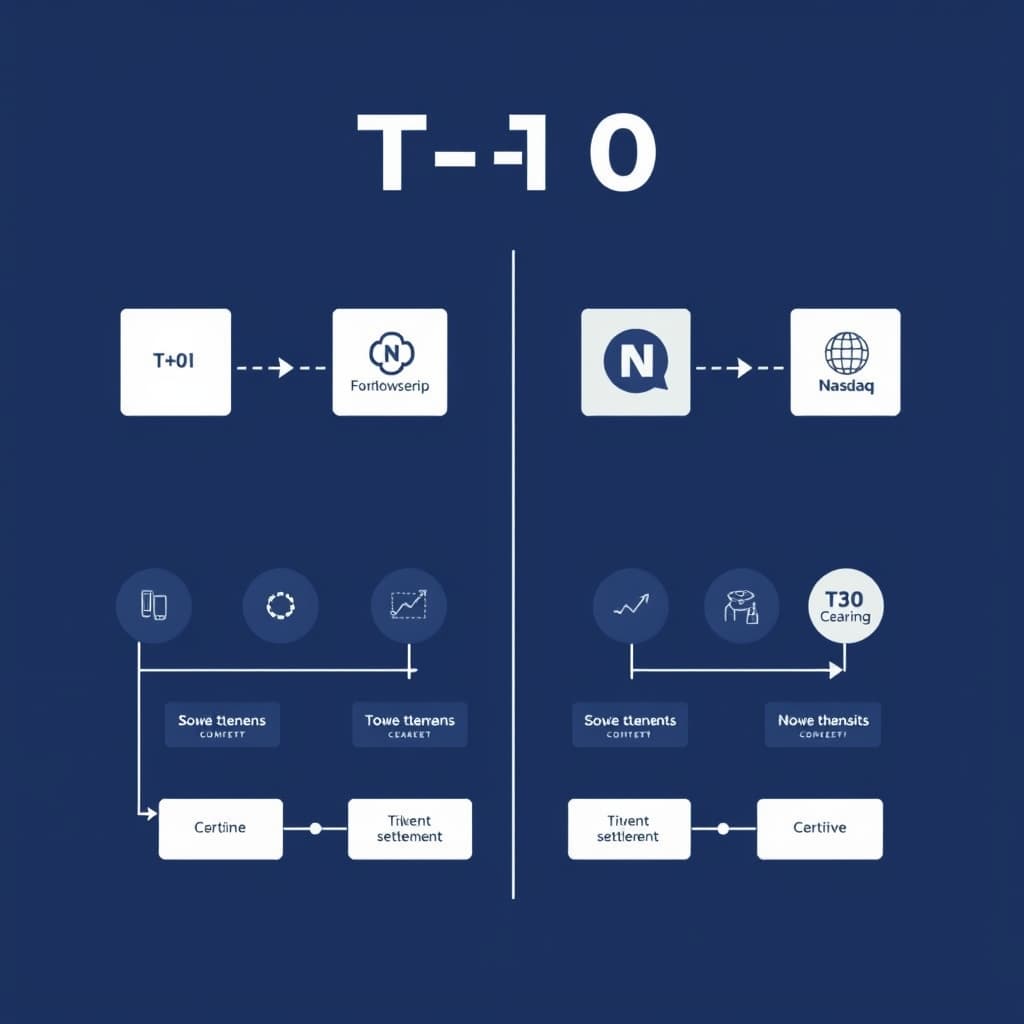
The popular narrative suggests Wall Street is simply adopting crypto technology, but the reality is far more surgical. Nasdaq is not running a decentralized exchange. Instead, they have decoupled the matching engine from the settlement layer. Orders for tokenized securities sit on the exact same central limit order book (CLOB) as traditional shares. The innovation triggers post-match. When an algorithmic trading firm routes an order with a specific "tokenization flag," the system executes the trade using standard price-time priority, then routes the settlement instructions to a permissioned smart contract environment rather than the traditional Continuous Net Settlement (CNS) system.
The SEC did not approve a wild west of peer-to-peer trading. The Depository Trust Company (DTC) remains the ultimate arbiter of truth, acting as the bridge between legacy book-entry databases and the new distributed ledger. If a tokenized settlement fails—perhaps due to an incompatible wallet address or a network latency spike—the system automatically defaults back to traditional T+1 settlement without breaking the trade. This fallback mechanism was the regulatory silver bullet that secured SEC approval.
Table 1: Execution & Settlement Architecture Comparison
Counterparty risk is the invisible tax on global liquidity. In a T+1 environment, a market maker must post margin to the clearinghouse to cover the risk of default between execution and settlement. Atomic settlement eradicates this duration risk. Cash and tokenized assets swap simultaneously. For quantitative funds executing millions of trades daily, reducing settlement latency from 24 hours to milliseconds frees up massive balance sheets previously trapped in clearinghouse margin accounts.
Case Study: The DTC Tokenization Pilot and the "Tokenization Flag"
To understand the immediate economic shift, look at the mechanics of the DTC pilot program launched under the new Nasdaq rule. A high-frequency trading desk buying 10,000 shares of an S&P 500 ETF can now append a "tokenization flag" to their FIX protocol order message. Upon execution, the DTC mints the corresponding tokenized shares and settles the transaction atomically against a tokenized cash equivalent. In the first simulated stress tests of this pilot, participating market makers reported a drastic reduction in overnight capital requirements. They no longer had to finance the 24-hour float. This is not just an IT upgrade; it is a fundamental repricing of liquidity provision.
The transition to tokenized securities forces a rewrite of institutional execution algorithms. Quants are now factoring settlement velocity into their routing logic. If an asset can settle instantly, the cost of capital assigned to that specific trade drops. Algorithms are being tuned to preference liquidity pools and order types that support atomic settlement flags, creating a two-tiered market efficiency: the fast-settling digital tier and the capital-heavy legacy tier.
Holding digital bearer instruments requires a completely different security paradigm than holding traditional book-entry stocks. Institutional custodians are aggressively upgrading their infrastructure, shifting from simple database management to multi-party computation (MPC) wallets and hardware security modules (HSMs) integrated directly with broker-dealer systems.
The Map of Incentives: Who Wins and Who LosesNasdaq’s regulatory victory places immense pressure on rival exchanges. The Intercontinental Exchange (parent of the NYSE) and the London Stock Exchange (LSE) are now functionally behind the curve. Liquidity is mercenary; it flows to the venue with the lowest friction and highest capital efficiency. If Nasdaq successfully scales its tokenized Russell 1000 and S&P 500 products, competing exchanges will be forced to accelerate their own blockchain integrations or risk losing market share to Nasdaq's superior settlement architecture.
Table 2: Global Exchange Tokenization Readiness (2026)
Looking toward the end of the decade, the current permissioned ledger model is merely a stepping stone. Nasdaq's recent partnerships with digital asset gateways signal a future where tokenized equities might eventually interact with permissionless decentralized finance (DeFi) networks, provided strict KYC/AML wrappers are maintained. The ultimate end-state for 2030 is a unified global liquidity pool where a tokenized share of a US tech company can be used as collateral in a decentralized lending protocol in real-time.
Nasdaq's regulatory victory establishes a definitive legal foundation for blockchain-based capital markets. The focus now shifts toward implementation execution and how quickly broker-dealers can upgrade their legacy systems to interface with this new tokenized infrastructure. The technology has been proven, the legal barriers have been breached, and the race to re-architect global liquidity has officially begun.
What exactly is an exchange-integrated tokenized security?
It is a digital representation of a traditional equity or bond issued on a distributed ledger that is legally recognized, traded, and settled directly on a major public exchange rather than an alternative trading system.
Does this SEC approval mean retail investors can buy tokenized stocks directly from self-hosted crypto wallets?
Not directly. While the underlying technology leverages blockchain for settlement, retail access will still require KYC-compliant brokerage accounts that interface with Nasdaq's digital asset infrastructure to ensure regulatory compliance.
Loading comments...