
Crypto
Sovereign Blackout Liquidity: How Nation-States Move Capital When the Grid Goes Dark
March 14, 2026
...


The State of Wisconsin Investment Board and hedge fund giant Millennium Management recently disclosed combined positions exceeding $2 billion in spot Bitcoin ETFs via SEC Form 13F filings. This is not a speculative retail allocation, but a calculated institutional defense mechanism against deteriorating fiat infrastructure. The traditional portfolio allocation strategy is fracturing under the weight of geopolitical instability and expanding sovereign debt. Smart money is actively rotating capital to protect purchasing power, utilizing digital assets to isolate portfolios from fiat currency debasement and central bank policy errors. By applying cross-asset correlation analysis and sovereign credit risk modeling, this assessment evaluates the mechanics and implications of this capital migration.
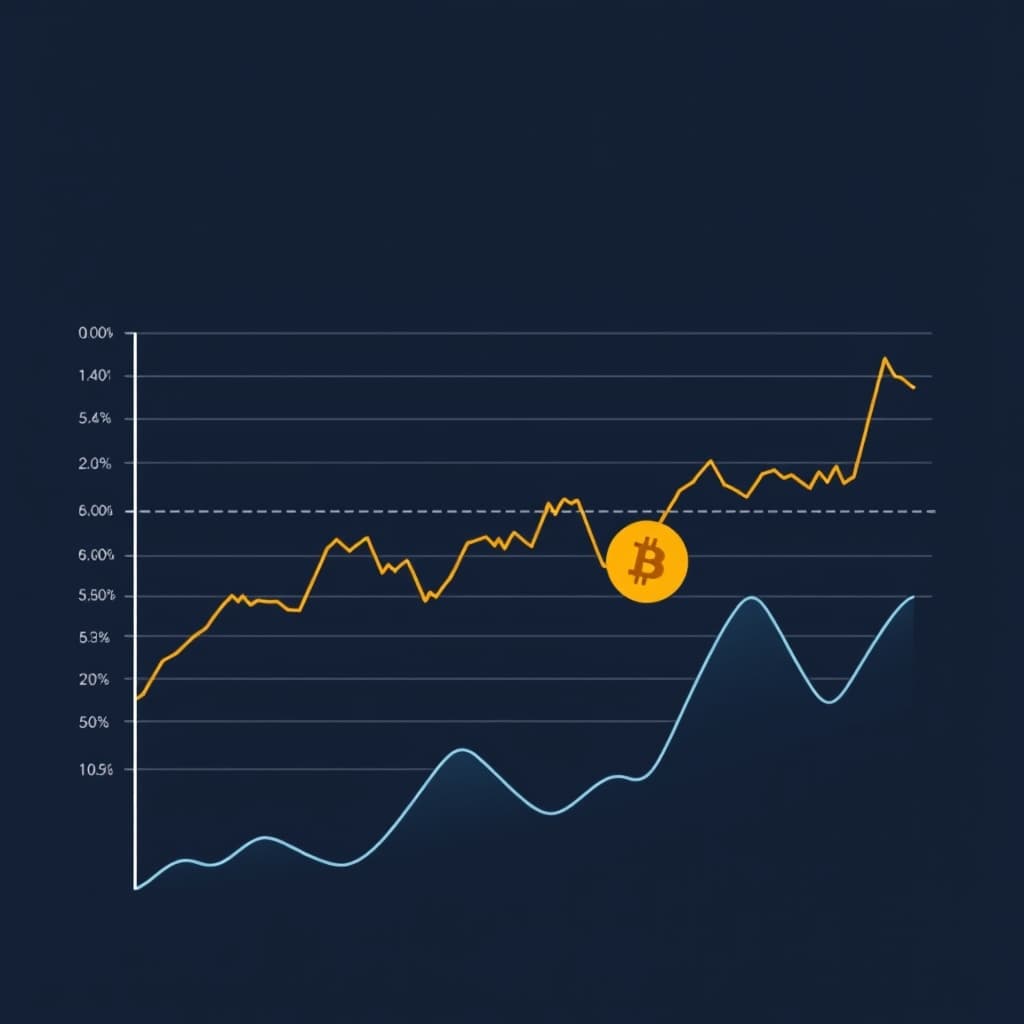
The foundational premise of modern portfolio theory relies on the risk-free rate provided by U.S. Treasuries. That premise is currently undergoing severe stress testing. Following earlier downgrades by S&P in 2011 and Fitch in 2023, Moody’s lowered the U.S. sovereign credit rating to Aa1 in May 2025. This adjustment was driven by an escalating federal deficit, surging interest rate expenses, and political gridlock surrounding debt ceiling negotiations.
When the entity issuing the risk-free asset faces structural solvency questions, institutional allocators are forced to seek alternative base-layer collateral. The cost of servicing U.S. debt is absorbing an increasingly disproportionate share of federal revenue, fundamentally altering the risk profile of long-duration government bonds. Sovereign credibility hedging emerges directly from this mathematical reality, as fiduciaries require assets that cannot be arbitrarily inflated to monetize sovereign liabilities.
Geopolitical tension acts as a catalyst for capital flight toward neutral settlement networks. The weaponization of the global financial system—specifically the freezing of sovereign reserves and exclusion from the SWIFT network—has forced non-aligned nations to reconsider their reliance on dollar-denominated assets.
This environment accelerates the search for absolute digital scarcity. Unlike physical commodities, which are subject to supply chain disruptions and confiscation risks, decentralized cryptographic networks offer frictionless cross-border mobility. Institutions recognize that in a multi-polar world, a non-state bearer asset provides a unique utility: it remains completely agnostic to international sanctions and trade embargoes, ensuring capital preservation regardless of the prevailing geopolitical climate.
The capital rotation into digital assets is empirically verifiable through SEC EDGAR regulatory disclosures and ETF flow data. In early 2026, U.S. spot Bitcoin ETFs recorded a staggering $1.1 billion in net inflows over a single three-day period, ending weeks of consolidation and pushing cumulative three-week inflows to $2.1 billion.
These inflows are not driven by retail exuberance. Form 13F filings reveal deep structural accumulation by entities managing hundreds of billions in assets. Beyond Millennium Management and the State of Wisconsin, sovereign wealth funds such as the Emirate of Abu Dhabi’s Mubadala Fund have initiated significant positions. This represents a permanent shift in the Overton window of institutional finance; holding zero exposure to digital assets is now increasingly viewed as a breach of fiduciary duty rather than a prudent risk-management stance.
Case Study: The Corporate Treasury Standard Corporate entities are actively replacing depreciating fiat reserves with hard-capped digital commodities. In early 2026, MicroStrategy executed a $1.57 billion acquisition, increasing its total holdings to over 760,000 BTC. Concurrently, Tokyo-listed Metaplanet secured $255 million from global investors to accelerate its own digital treasury strategy, directly citing the rapid depreciation of the Japanese Yen as the primary catalyst.
These corporations are effectively shorting fiat currency by issuing low-interest convertible debt and purchasing a provably scarce asset. This arbitrage exploits the discrepancy between the real inflation rate and the artificially suppressed cost of corporate borrowing. The second-order effect is the creation of a new corporate standard where equity valuations command a premium based on the quality of the underlying treasury reserve.
In March 2026, Bitcoin broke through the $75,000 psychological resistance level, achieving a market capitalization of $1.48 trillion. This price action coincided directly with heightened tensions in the Middle East, specifically concerning shipping routes through the Strait of Hormuz.
Historically, risk assets experience severe drawdowns during kinetic military conflicts. Bitcoin's behavior during this period demonstrated characteristics of a "digital safe haven" beta. On-chain data indicated that wallets holding between 10 and 10,000 BTC aggressively accumulated during localized price dips, absorbing sell pressure and reinforcing the $70,000 support zone. This resilience confirms that algorithmic scarcity is being priced as a premium insurance policy against systemic geopolitical shocks.
The correlation matrix between digital assets and traditional equities is undergoing a structural decoupling. During the March 2026 geopolitical stress events, West Texas Intermediate (WTI) crude oil experienced extreme volatility, and gold retested its 50-day simple moving average as support. Simultaneously, Bitcoin advanced by 4% in a single trading session, outperforming the S&P 500.
This divergence is critical for quantitative analysts. If Bitcoin consistently demonstrates an inverse correlation to fiat liquidity crises while maintaining independence from equity drawdowns, its inclusion in a diversified portfolio drastically improves the Sharpe ratio. The asset is transitioning from a high-beta technology play to a non-sovereign monetary base layer.
Central banks operate on a mandate of stability, yet their balance sheets are increasingly saturated with impaired sovereign debt. The game theory of international reserves dictates that the first central bank to openly accumulate a hard-capped digital asset secures a massive asymmetric advantage.
While public declarations remain sparse, the groundwork is visible. Regulatory harmonizations, such as the joint efforts between the SEC and CFTC in early 2026, provide the legal clarity required for sovereign entities to interact with digital asset custodians. As the U.S. dollar's share of global reserves continues its secular decline, central banks are forced to model scenarios where a neutral, cryptographic ledger serves as a supplementary settlement layer for international trade.
The regulatory environment is shifting from hostility to capture. By approving spot ETFs and options trading, regulators have integrated digital scarcity into the legacy financial plumbing. This prevents capital flight from the U.S. financial system while simultaneously subjecting the asset to traditional surveillance and taxation frameworks.
The standard 60/40 portfolio is fundamentally unequipped to handle simultaneous equity drawdowns and bond market sell-offs triggered by sovereign credit downgrades. Quantitative models must now incorporate sovereign default probabilities into their risk-free rate assumptions.
Allocators are implementing the Sovereign Credibility Hedge by reallocating 2% to 5% of the fixed-income sleeve into digital assets. This acts as a convexity trade; the downside is capped at the principal investment, while the upside scales logarithmically in the event of a rapid fiat currency devaluation.
The primary constraint of holding absolute digital scarcity is the lack of native yield. To optimize portfolio performance for 2026 and beyond, data scientists must balance yield-generative assets (such as dividend-paying equities and high-grade corporate credit) with non-yielding digital commodities.
This balance is achieved by utilizing digital assets as pristine collateral. As regulatory frameworks mature, institutions can post digital commodities to secure low-interest fiat loans, which are then deployed into yield-bearing instruments. This strategy preserves the underlying sovereign hedge while generating the cash flow necessary to meet institutional liabilities.
The current institutional allocation to digital assets represents a fundamental macro regime shift rather than a temporary speculative wave. Capital allocators must closely monitor central bank balance sheet expansions and sovereign debt issuance to time their continued diversification into non-state assets.
What exactly is sovereign credibility hedging? It is the practice of allocating capital into decentralized, non-state assets to protect portfolios against the risk of fiat currency debasement, erratic monetary policy, or sovereign debt defaults.
Why are institutions choosing Bitcoin over gold for this specific hedge? Bitcoin offers superior verifiability, absolute digital scarcity, and frictionless cross-border settlement, making it highly responsive to sudden geopolitical shocks compared to physically constrained commodities.
Loading comments...