
Deep Analysis
Bittensor (TAO) Institutional Adoption: Subnet Expansion and Corporate Treasury Dynamics
April 01, 2026
...


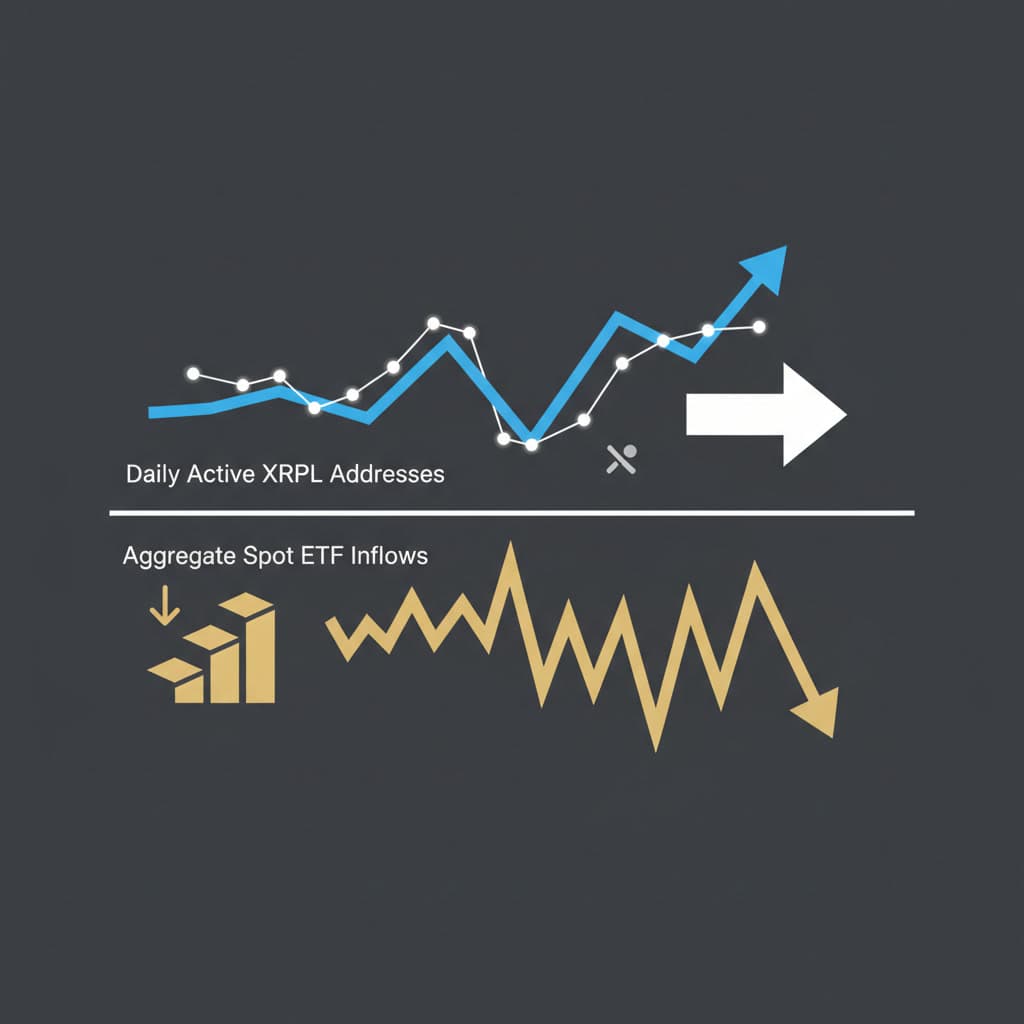
U.S. spot XRP ETFs shed $31 million in net assets during March 2026, marking a sharp divergence from the $1.44 billion in cumulative inflows recorded since their initial launch. This decoupling between institutional wrapper demand and on-chain utility—where large wallets accumulated 40 million tokens over the exact same period—requires a structural reassessment of Ripple’s ecosystem. Utilizing a dual-framework analysis that bridges macroeconomic capital flow velocity with XRP Ledger (XRPL) technical mechanics, this evaluation examines how the integration of the RLUSD stablecoin, shifting corporate treasury strategies, and critical technical support zones near $1.30 are redefining the asset's market architecture. Institutional capital allocation within the digital asset sector faces a pivotal stress test as XRP navigates heightened volatility and these critical technical thresholds in Q2 2026. Readers will gain a comprehensive understanding of Ripple's corporate treasury shifts, the strategic integration of the RLUSD stablecoin, and the macroeconomic factors dictating the asset's structural resilience.
The introduction of the RLUSD stablecoin, which rapidly achieved a $1.56 billion market capitalization by early 2026, has fundamentally altered how multinational corporations interact with the XRP Ledger. Historically, native XRP functioned as the sole bridge asset for On-Demand Liquidity (ODL) corridors. Today, corporate treasuries are optimizing their balance sheets by bifurcating their digital asset exposure. The XRPL’s Federated Byzantine Agreement consensus protocol enables 3-5 second transaction finality at a fraction of a cent, but the volatility of a floating-rate asset like XRP introduces foreign exchange risk during the settlement window.
By integrating RLUSD—a fully reserved, fiat-backed stablecoin overseen by the New York Department of Financial Services (NYDFS)—Ripple has provided CFOs with a programmable, non-volatile settlement layer. This shift allows treasuries to generate operational yield through stablecoin deployment in tokenized money market funds, such as BlackRock's BUIDL, which utilizes RLUSD as an on-demand settlement off-ramp.
Map of Incentives:The mechanics of cross-border liquidity routing now operate on a dual-rail system. RLUSD acts as the primary vehicle for high-volume, low-volatility corridors (e.g., USD to EUR), while native XRP remains essential for exotic fiat corridors where deep stablecoin liquidity is absent. This "stablecoin sandwich" model—where fiat is converted to RLUSD, routed across the XRPL, and settled in local fiat—reduces friction but alters the tokenomics of the native asset.
Mini Case Study: The Q1 2026 ETF Liquidity Contraction When the first wave of spot XRP ETFs launched in late 2025, issuers like Canary Capital and Bitwise captured $164 million on their first trading day, going 35 consecutive days without a net outflow. By March 2026, the narrative shifted. The category experienced its first negative milestone, shedding $31 million in net assets. This contraction was not driven by structural flaws in the wrappers themselves, but by a broader digital asset rotation and a lack of secondary market liquidity provision. As XRP's price declined 43% from its local peaks, dropping below $1.40, institutional allocators hesitated to deploy fresh capital. The case of the Franklin Templeton XRPZ fund, despite offering a highly competitive 0.19% fee, illustrates that low expense ratios cannot overcome macro-level risk aversion when the underlying asset breaks critical technical supports.
To understand the current stagnation, it is necessary to measure XRP ETF asset under management (AUM) velocity against historical analogs. The current cumulative AUM of approximately $1 billion represents roughly 0.8% of XRP's circulating supply locked in cold storage.
The data indicates that while initial retail and high-net-worth demand was robust, wirehouse platforms and sovereign wealth funds remain sidelined. Market makers are currently awaiting clearer regulatory precedents regarding the SEC's classification of secondary market liquidity provisions before committing to large-scale block trades.
South Korea remains a critical liquidity hub for digital assets, characterized by high retail penetration and stringent regulatory oversight. The implementation of the Act on the Protection of Virtual Asset Users has mandated that Virtual Asset Service Providers (VASPs) hold 80% of customer funds in cold wallets and maintain strict segregation of assets. Ripple’s strategic decision to secure a listing for RLUSD on Coinone, a top-tier South Korean exchange, directly capitalizes on this regulated environment.
By operating within the framework enforced by the Korea Financial Intelligence Unit (KoFIU), Ripple is positioning RLUSD as a compliant alternative to the U.S. dollar for APAC-based institutions. This regulatory alignment provides a competitive moat against algorithmic stablecoins and offshore entities lacking transparent fiat reserves.
The inclusion of RLUSD in the South Korean market creates a unique dynamic for liquidity sourcing. Historically, the "Kimchi Premium" resulted in volume discrepancies between Asian and Western exchanges, driven by capital controls and isolated liquidity pools. The introduction of a highly liquid, NYDFS-regulated USD stablecoin directly paired with the Korean Won (KRW) allows institutional arbitrageurs to close these pricing gaps more efficiently.
For the native XRP token, this means a potential reduction in speculative trading volume on platforms like Upbit and Bithumb, as traders migrate to the stability of RLUSD for base-pair trading. The structural impact is a stabilization of order book depth, reducing the likelihood of isolated flash crashes but also dampening the explosive upside volatility historically associated with Asian retail frenzies.
From a quantitative perspective, the $1.30 to $1.35 range serves as a high-timeframe inflection point. Despite the spot price declining nearly 30% in early 2026, on-chain metrics reveal a distinct accumulation pattern. Over 738 million XRP were withdrawn from centralized exchanges in a single 24-hour period in March 2026, driving exchange balances to their lowest levels since 2018 (approximately 2.6 billion tokens).
This supply shock indicates that while ETF buyers are experiencing exhaustion, deeply capitalized on-chain entities—often referred to as whales—are building positions at the $1.30 support zone. The average cost basis for current holders sits near $1.44, creating a heavy resistance band just above the current spot price. A weekly close below the $1.30 floor risks triggering a cascading liquidation event toward the $1.15 macro support.
The final component of XRP’s 2026 market structure is its evolving correlation with macroeconomic indices and Bitcoin. If Bitcoin experiences a liquidity contraction toward the $45,000 threshold, historical beta models suggest XRP would face severe downward pressure. The integration of enterprise-grade cash flows via RLUSD and the locking of supply in ETF custody vehicles are beginning to alter this beta coefficient.
Stress testing the asset reveals that its resilience now depends less on retail sentiment and more on the velocity of corporate adoption. As traditional finance (TradFi) institutions integrate the XRPL for tokenized fund settlement, XRP is slowly decoupling from the broader speculative digital asset market, transitioning into a specialized infrastructure play.
The current market environment requires strict risk management as the asset consolidates near vital support zones. Market participants must monitor the adoption metrics of RLUSD and subsequent ETF capital flow shifts to gauge the probability of a sustained macroeconomic reversal. As institutional capital continues to test the infrastructure of the XRP Ledger, the divergence between on-chain utility and wrapper demand will dictate the asset's trajectory through the remainder of 2026.
How does the introduction of RLUSD alter the utility of native XRP in cross-border settlements? RLUSD acts as a complementary liquidity vehicle, providing a fiat-pegged alternative for corporate treasuries, while the native token remains the primary bridge asset for volatile, high-speed international corridors requiring trustless execution.
Why are spot XRP ETFs experiencing delayed capital accumulation? Initial tepid demand stems from broader digital asset rotation trends and institutional hesitancy, as market makers await clearer regulatory precedents regarding secondary market liquidity provisions and definitive custody frameworks.
Loading comments...