
Deep Analysis
Solana (SOL) Q2 2026 Institutional Outlook: Evaluating the $80 Support Level Amidst Macro Outflows
March 31, 2026
...


Institutions and quantitative funds allocating capital to decentralized AI infrastructure face a critical duration-matching risk: balancing the volatility of tokenized compute against the yield generated by subnet emissions. The intersection of decentralized artificial intelligence and institutional capital has reached a critical inflection point. By applying on-chain structural flow analysis and corporate treasury behavioral models to the Bittensor ecosystem, this analysis maps how the Covenant-72B model integration and corporate treasury staking strategies fundamentally recalibrate token utility and network valuation.
The recent deployment of the Covenant-72B model forces a hard reset on the baseline computational requirements for network participants. Covenant-72B embeds advanced base-model capabilities directly into the network architecture, shifting validator consensus mechanisms to prioritize high-fidelity inference generation over simple data routing. The immediate constraint here is hardware acquisition. Miners must now deploy enterprise-grade GPU clusters rather than consumer-grade hardware to remain competitive. A second-order effect of this architectural upgrade is the centralization of mining power among well-capitalized entities, squeezing out fragmented retail operators who cannot meet the new cryptographic proof-of-work thresholds.
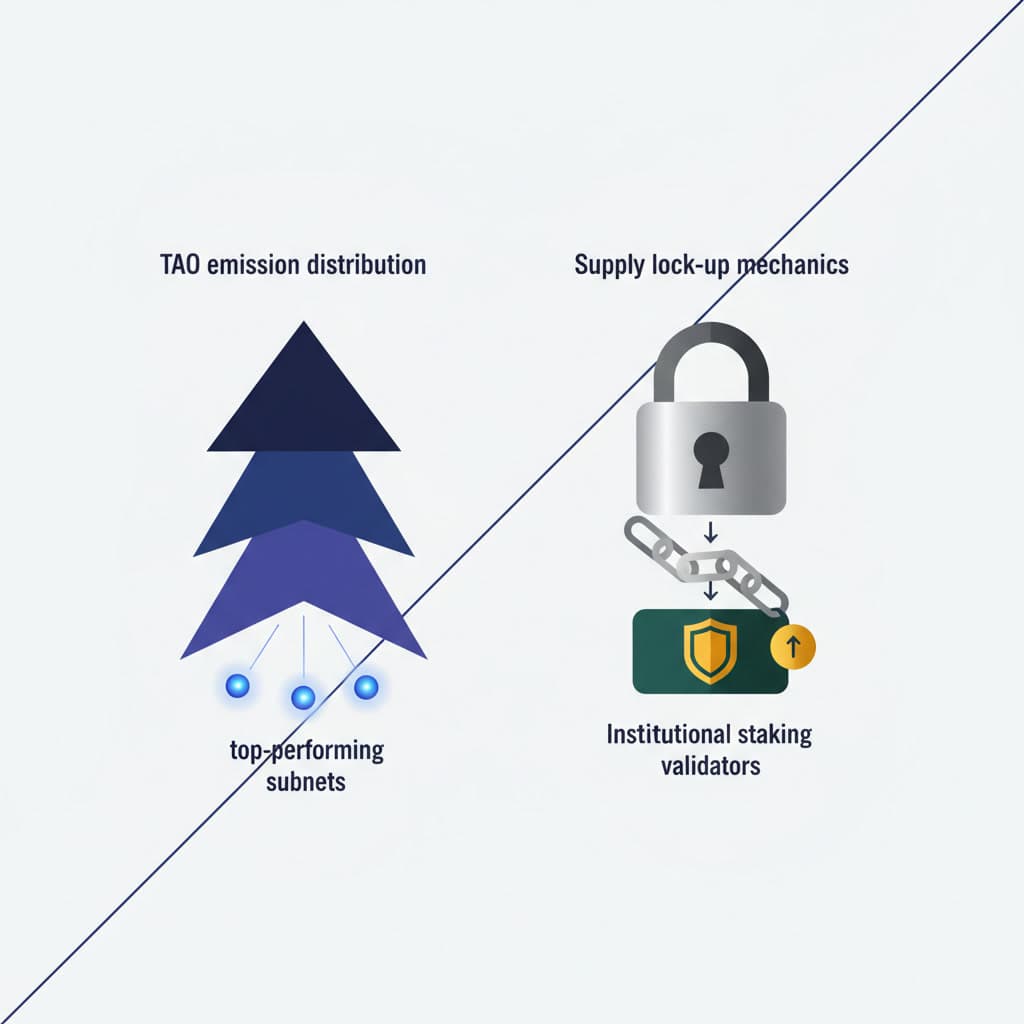
Under the current dynamic emission schedule, exactly 7,200 TAO are distributed daily across active subnets. The Covenant-72B launch triggered an explosion of subnet forks, as developers optimize the model for specialized tasks—ranging from zero-knowledge machine learning (zk-ML) to multimodal data processing. The competition for the daily emission block forces subnet creators to continuously refine their incentive mechanisms. If a subnet fails to attract high-quality miner output, the consensus engine programmatically slashes its emission allocation. This ruthless meritocracy ensures that only the most performant nodes receive ALPHA token distributions, though it simultaneously heightens the risk of subnet abandonment for niche AI applications lacking immediate commercial viability.
The transition of TAO from a speculative infrastructure asset to a yield-bearing treasury instrument is explicitly demonstrated by the recent actions of TAO Synergies (NASDAQ: TAOX). By concentrating its corporate treasury in staked TAO tokens, TAOX captures the baseline APY generated by network emissions while securing governance influence over subnet parameters. The mechanics involve delegating liquid TAO to high-performing validators, effectively converting static balance sheet capital into active network bandwidth. This strategy requires precise risk management, as treasury managers must hedge against the underlying asset's volatility while locking up capital in illiquid staking contracts.
Public entities aggressively staking TAO execute a systematic removal of liquid supply from retail markets. With a capped maximum supply of 21 million tokens and a programmatic halving schedule, institutional lock-ups severely restrict the circulating float. The second-order effect is the establishment of a synthetic floor price based on institutional yield targets. When traditional finance signals confidence in decentralized AI infrastructure through balance sheet integration, it triggers algorithmic accumulation across secondary markets, driving up the cost basis for new network entrants.
Map of Incentives:Trading at $322.98 with a market capitalization ranking of #33, TAO is priced as a foundational base layer rather than a localized application. Comparing Bittensor's fully diluted valuation (FDV) to centralized Web2 AI providers reveals a distinct premium placed on decentralization and censorship resistance. Traditional valuation models struggle here; the network does not generate fiat revenue but rather produces tokenized intelligence.
The 24-hour trading range of $302.25 to $328.82, representing a 6.24% positive variance, reflects immediate market repricing following the Covenant-72B announcement and the TAOX treasury disclosure. Quantitative order book analysis indicates that the $322 level acts as a high-volume node. Institutional accumulation algorithms are absorbing retail profit-taking at this support level. The constraint for traders is the relatively thin liquidity on centralized exchanges compared to the staked supply, meaning that even moderate spot buying can trigger outsized price action.
Looking toward the 2026-2030 cycle, the bandwidth requirements for synchronizing decentralized Large Language Models (LLMs) across global subnets will scale exponentially. The network must evolve beyond simple parameter passing to support fully homomorphic encryption and compressed state proofs. The primary constraint will be network latency; ensuring data integrity without saturating node connections will require breakthroughs in zero-knowledge proof generation. Subnets that fail to optimize their communication overhead will be penalized by the consensus mechanism, leading to rapid capital flight.
As traditional equities like TAOX blur the line between corporate treasuries and decentralized networks, regulatory friction will inevitably intensify. The SEC's evolving stance on protocol staking—specifically differentiating between administrative validation and entrepreneurial investment contracts—will dictate the pace of institutional adoption.
Bittensor's transition from speculative infrastructure to an institutional yield-bearing asset marks a distinct maturation phase for decentralized computing. Sustained network growth now hinges on subnet performance maintaining pace with aggressive corporate liquidity lockups. If the underlying AI models fail to generate real-world utility, the institutional yield thesis collapses, leaving treasury managers holding highly illiquid, depreciating tokens.
How does the Covenant-72B launch alter Bittensor's subnet incentive structure? Covenant-72B introduces advanced base-model capabilities directly into the network architecture, shifting validator consensus mechanisms to reward high-fidelity inference generation over simple data routing, thereby increasing the technical threshold for miners.
What is the structural significance of public companies utilizing TAO for their corporate treasuries? Public entities staking TAO effectively remove liquid supply from retail markets, establishing a floor price based on institutional yield targets while signaling traditional finance confidence in decentralized AI infrastructure.
Loading comments...