
The Death of Shared Ledgers: Why 2026 Marks the Era of Corporate Blockspace Sovereignty
The narrative that public blockchains act as a singular "world computer" where all applications share resources is rapidly becoming obsolete for enterprise use cases. The general-purpose Layer 2 (L2) model—where a decentralized exchange competes for blockspace with a viral memecoin or an NFT mint—introduces unacceptable latency variances and cost unpredictability for institutional actors.
By 2026, the dominant architectural trend will not be the scaling of shared ledgers, but the proliferation of Corporate Blockspace Sovereignty. This shift, highlighted by VanEck’s forecast of a corporate blockchain war, represents a fundamental pivot from "renting" execution environments to owning them. Corporations are realizing that controlling the sequencer—and by extension, the transaction ordering, fee markets, and access rules—is the only viable path to integrating Web3 infrastructure with legacy corporate mandates.
Escaping the Noisy Neighbor: The Economics of Dedicated Blockspace
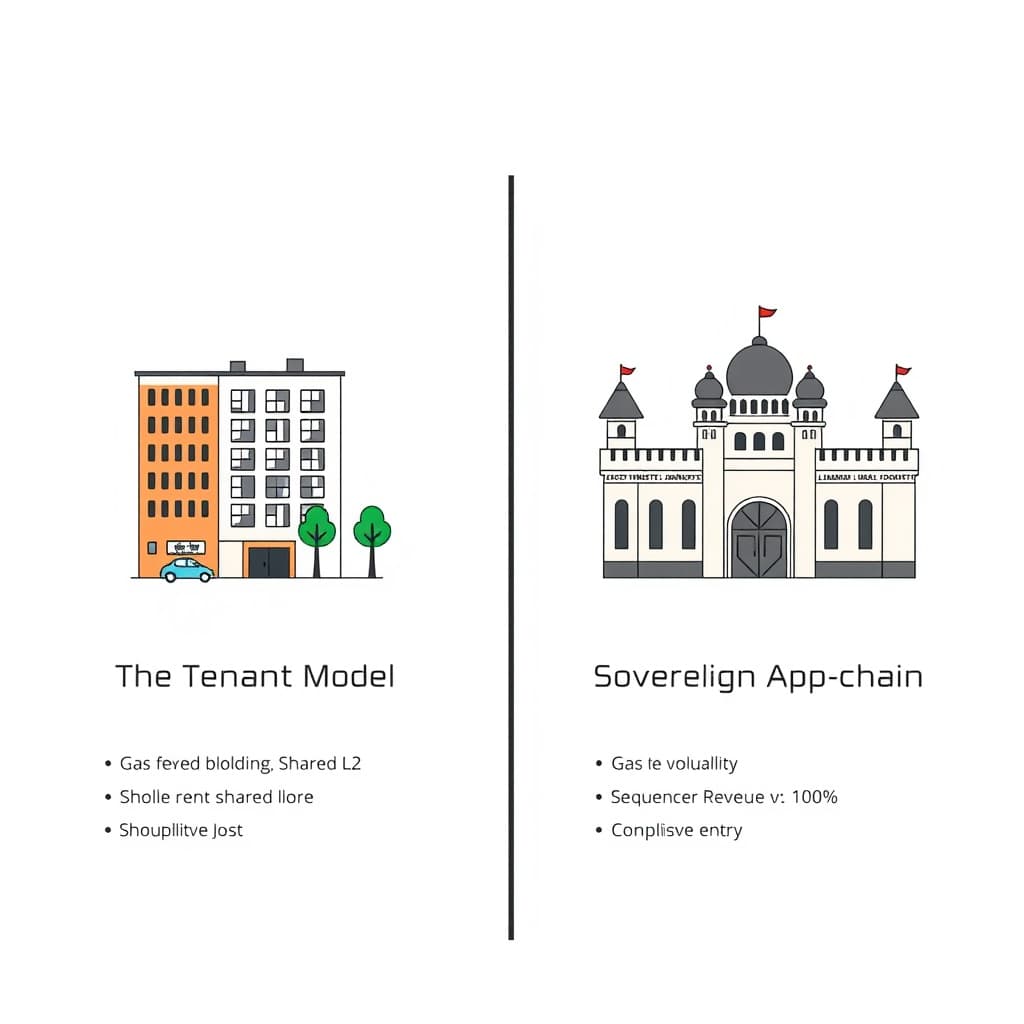
For the last cycle, corporate strategy involved deploying smart contracts on shared environments like Ethereum Mainnet, and later, generalized L2s like Arbitrum One or Optimism. This "Tenant Model" carries a fatal flaw: the "noisy neighbor" problem. When network activity spikes due to an unrelated event—such as a high-profile token launch—gas fees rise and confirmation times degrade for all users, regardless of the application's relevance to the traffic spike.
Corporate Blockspace Sovereignty solves this through isolation. By launching a sovereign app-chain (Layer 3 or dedicated L2), an entity decouples its performance from the broader market.
From Cost Center to Revenue Generator
The most compelling argument for sovereignty is financial. In a shared L2 model, the application drives users to the chain, but the chain operator captures the sequencer revenue (the spread between fees collected from users and the cost to post data to Ethereum).
In a sovereign model, the corporation owns the sequencer. This flips blockchain infrastructure from a cost center (paying gas) to a profit generator.
Modular Frameworks as the New Corporate Operating System
The barrier to entry for launching a blockchain has collapsed due to modular development kits. The "SaaS-ification" of blockchain infrastructure is driven by frameworks like the OP Stack (Optimism), Arbitrum Orbit, and Polygon CDK. These toolkits function similarly to how Kubernetes allowed companies to manage their own cloud environments rather than relying on rigid hosting providers.
This technological maturity allows for granular customization previously impossible on public chains. A critical feature is the Custom Gas Token. On a sovereign chain, a corporation is not forced to make users pay in ETH. A gaming giant like Sony (with Soneium) or a fintech operator can abstract gas fees entirely, allowing users to pay in stablecoins, the platform's native token, or fiat via credit card, while the sequencer handles the backend settlement costs.
This capability effectively removes the "crypto" friction from the user experience, transforming the blockchain from a user-facing hurdle into invisible backend infrastructure.
Regulatory Moats: Why Compliance Demands Sovereign Chains
Institutional capital cannot flow freely through permissionless pools where sanctioned entities might be counterparties. This is the regulatory glass ceiling of DeFi. Shared ledgers are, by design, censorship-resistant and permissionless. While philosophically aligned with crypto ethos, this is legally toxic for regulated entities.
Sovereign chains introduce Sequencer-Level Compliance. Because the corporation runs the sequencer, it can implement a whitelist or KYC gate before a transaction is ever included in a block.
The Permissioned-on-Public Paradox
We are witnessing the rise of "Walled Gardens" built on public infrastructure. A bank can launch a chain using Polygon CDK that settles to Ethereum (inheriting its security) but restricts transaction submission to KYC-verified wallets. This allows for:
- Sanctions Screening: Automatically rejecting transactions from OFAC-listed addresses.
- Asset Controls: Enforcing transfer restrictions on security tokens at the protocol level.
- Privacy Sharding: Keeping sensitive data off-chain or in a validium data availability layer while posting only proofs to the public ledger.
The Liquidity Fragmentation Trap and the Interoperability Race
The migration to sovereign chains is not without significant risk. The primary trade-off is Liquidity Fragmentation. In the shared model, a dApp on Arbitrum benefits from the billions of dollars of liquidity already present on that network. A standalone chain is an island; it starts with zero liquidity and zero users.
If 2026 is the year of the app-chain, it will also be the year of the Aggregation Layer. The success of Corporate Blockspace Sovereignty hinges on the ability to abstract cross-chain bridging.
Table 2: The Sovereignty Trade-off MatrixProjects like the Optimism Superchain and Polygon AggLayer attempt to solve this by creating a mesh of interoperable chains that share a bridge and liquidity. For a corporation, joining such an alliance is crucial. It offers the control of a sovereign chain with the connectivity of a shared network.
Strategic Outlook: The Battle for the 'Superchain' Ecosystem
The market is currently witnessing a vertical integration strategy reminiscent of the early mobile internet. Major players are not just building dApps; they are building the roads those dApps drive on.
Coinbase’s Base provided the blueprint: incubate a chain, integrate it into the consumer frontend (the exchange), and capture the ecosystem revenue. Sony’s Soneium and Uniswap’s Unichain are following suit.
By 2026, we expect a consolidation where thousands of sovereign chains launch, but only those integrated into a "Superchain" cluster will survive. The winners will be ecosystems that successfully hide the complexity of bridging. If a user has to manually switch networks in their wallet, the product has failed. The interface must treat disparate chains as a unified backend.
Corporate sovereignty is inevitable because institutions demand control over their execution environments. The winners of 2026 will not be the chains with the highest theoretical throughput, but the ecosystems that successfully abstract the complexity of bridging while retaining the security of the settlement layer.
FAQ
What is the difference between a shared L2 and a sovereign app-chain? A shared L2 (like Optimism Mainnet) hosts thousands of unrelated applications competing for the same blockspace resources. A sovereign app-chain is a dedicated blockchain instance tailored to a single entity's specific throughput, fee structure, and compliance needs, often settling back to a larger chain like Ethereum.
How does corporate blockspace sovereignty affect Ethereum? It reinforces Ethereum's role as the global settlement layer. While execution moves to proprietary chains to optimize for speed and cost, these chains still pay "rent" to Ethereum for data availability and security. This solidifies ETH as the foundational asset of the digital economy, even if users rarely interact with the mainnet directly.
Sources
Loading comments...
Related
View all →


Crypto
Enterprise Stablecoin Inflection: Why Corporate Finance is Nearing its 'ChatGPT Moment'
March 28, 2026
...