


New Hampshire’s $100M Bitcoin Bond: The Dawn of Crypto-Backed Municipal Debt
In late 2025, asset manager Wave Digital Assets and fixed-income specialist Rosemawr Management quietly finalized a structure allowing a CleanSpark-linked entity to pledge Bitcoin as collateral for municipal debt. This was not a private credit facility; it was the architectural foundation for New Hampshire's unprecedented $100 million Bitcoin-backed conduit bond. Having spent over 15 years structuring fixed-income derivatives and analyzing municipal securitization, I view this issuance not as a mere novelty, but as a fundamental rewrite of public finance mechanics. Bridging legacy municipal debt with programmable, highly volatile collateral forces a total recalculation of how local governments can fund civic infrastructure without tapping the taxpayer base.
The integration of digital assets into the $140 trillion global debt market is no longer theoretical. New Hampshire’s Business Finance Authority (BFA) has engineered a mechanism that isolates the state from direct financial liability while capturing the economic upside of crypto-collateralized borrowing. To understand the viability of this model, one must dissect the securitization trust, evaluate the strict liquidation triggers, and analyze how legacy credit rating agencies are quantifying blockchain-native risk.
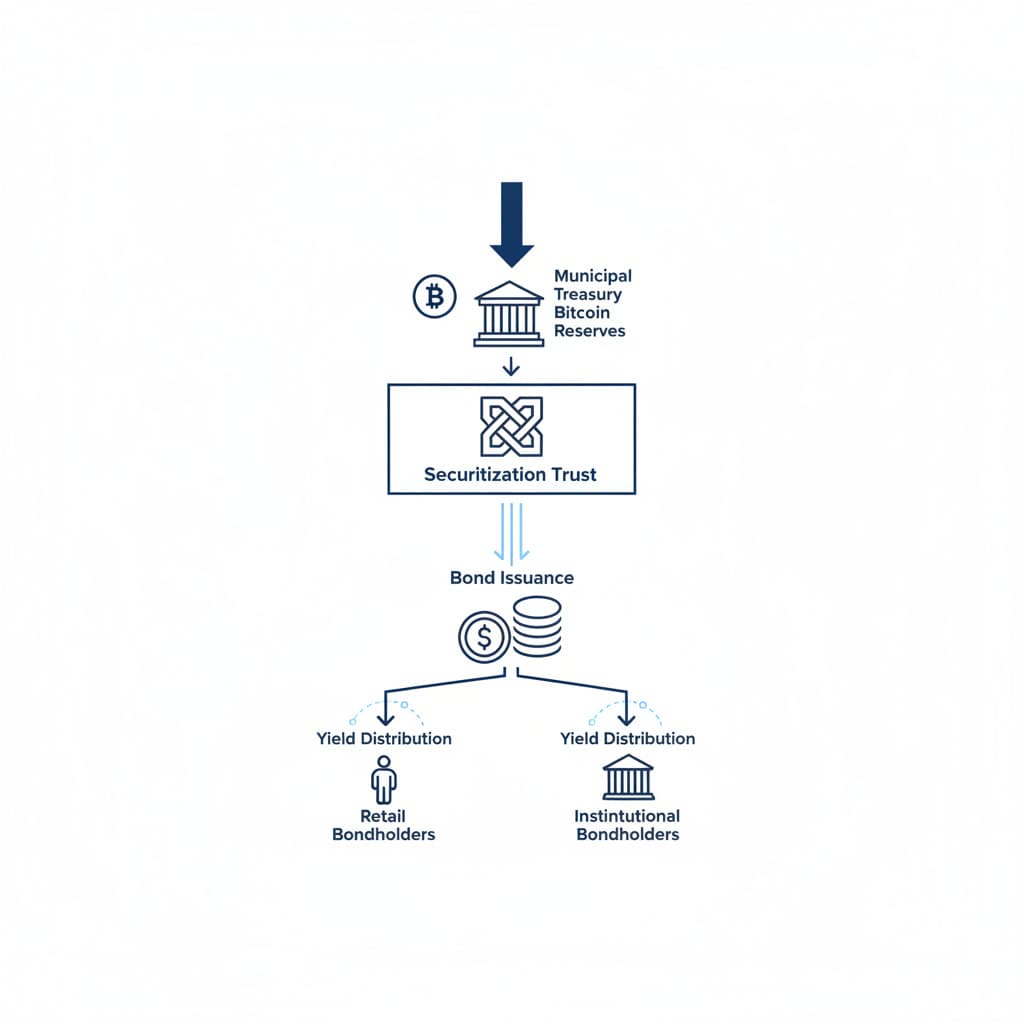
Decoding the Mechanics of Crypto-Collateralized Public Debt
The structural elegance of New Hampshire’s bond lies in its legal firewall. By acting as a conduit issuer, the state facilitates access to the tax-exempt or taxable municipal market for a private borrower without pledging its own full faith and credit.
Structuring the Securitization Trust
The underlying borrower for this initial issuance is NH Cleanspark Borrower Trust 2026-1, an entity that posts Bitcoin as the loan collateral. The state’s BFA issues the debt—split into Series 2026A-1 and Series 2026A-2 maturing in 2029—and funnels the proceeds to the borrower. The Bitcoin itself does not sit in a state treasury wallet; it is locked with BitGo Trust Company, acting as the qualified third-party custodian. If the borrower defaults on the coupon payments, the trust agreement dictates the immediate liquidation of the custodial Bitcoin to make the bondholders whole.
Volatility Mitigation and Overcollateralization Ratios
Because Bitcoin's annualized volatility routinely dwarfs that of fiat currencies and traditional municipal revenue streams, the securitization relies on aggressive overcollateralization. The arrangement launches at a strict 1.60x coverage ratio, meaning the custodial Bitcoin must be worth 160% of the outstanding loan balance at inception.
The trust incorporates algorithmic-style downside protection: a mandatory full redemption of the bonds is triggered if the coverage ratio deteriorates to 1.40x. This narrow margin prevents the collateral from slipping underwater during severe market drawdowns. The custodian operates on a two-day liquidation exposure window, theoretically providing enough time to unwind BTC positions into market depth before full settlement occurs, though flash crashes remain a systemic tail risk.
What Moody’s Ba2 Rating Means for Institutional Adoption
The most critical development in this issuance is not the technology, but the traditional financial validation. In early 2026, Moody’s Investors Service assigned the bond a provisional Ba2 rating.
Breaking the Speculative Grade Barrier
For municipal bond markets accustomed to state-level paper rated Aa or above, a Ba2 rating on a public authority structure is a jarring reality check. Ba2 places the instrument in speculative-grade territory—two notches below the lowest investment-grade threshold. This rating explicitly excludes the debt from the portfolios of strict investment-grade municipal bond funds, conservative pension systems operating under fiduciary floors, and insurance company general accounts subject to strict capital charge rules.
The natural buyers for this paper are high-yield municipal funds, multi-strategy hedge funds, and crypto-native fixed-income allocators looking for yield backed by hard assets rather than software company cash flows.
Credit Agency Methodologies for Digital Assets
Moody's methodology for rating this collateralized debt relies heavily on historical liquidity and price variance modeling.
Moody’s applied a 72.06% advance rate in its analysis. This massive haircut reflects the agency's assessment of Bitcoin's historical volatility and the liquidity constraints of selling tens of millions of dollars of block space during a potential broader market panic. S&P Global recently noted that while Bitcoin's volatility is trending downward, it remains exponentially higher than the Nasdaq-100 or gold, justifying the steep discount rate applied by credit analysts.
New Hampshire’s $100M Gamble on Civic Infrastructure
This bond issuance does not exist in a vacuum; it is the capstone of a multi-year legislative strategy to position the Granite State as the premier jurisdiction for digital asset capital markets.
Legislative Framework and State Treasury Operations
The groundwork was laid in May 2025 when Governor Kelly Ayotte signed HB 302 into law, establishing a framework for the state to accumulate digital assets and effectively creating America’s first Strategic Bitcoin Reserve. The law authorized the state treasurer to invest up to 5% of public funds in digital assets with market caps exceeding $500 billion. By pairing direct treasury reserves with conduit bond issuance, New Hampshire is attacking the crypto-finance convergence from both the sovereign savings and institutional borrowing angles.
Capital Allocation for Granite State Projects
The genius of the conduit structure is how it extracts value from private capital. Fees generated from the bond transaction, alongside any potential appreciation in the Bitcoin collateral, will flow directly into the state’s Bitcoin Economic Development Fund. This fund is earmarked to support entrepreneurship, business growth, and technological innovation. The state effectively monetizes its regulatory clarity, acting as a toll collector on the bridge between Wall Street fixed-income markets and institutional crypto miners.
Navigating the Regulatory Landscape of Tokenized Bonds
Issuing speculative-grade debt backed by an asset the SEC frequently scrutinizes requires meticulous regulatory navigation. Public finance entities must satisfy both legacy securities law and emerging digital asset frameworks.
SEC and MSRB Compliance Hurdles
Because the New Hampshire BFA is a municipal entity, the issuance falls under the purview of the Municipal Securities Rulemaking Board (MSRB). The disclosure requirements for a Ba2-rated, crypto-backed bond are immense. Issuers must clearly delineate to bondholders that Series 2026A-2 includes optional additional payments at maturity if Bitcoin appreciates sufficiently—an asymmetric upside feature almost unheard of in conventional municipal finance. Disclosing the exact mechanics of the 1.40x mandatory redemption trigger is critical to avoiding enforcement actions related to misleading fixed-income investors.
Custody Requirements for State-Owned Bitcoin
The SEC’s evolving stance on qualified custodians dictates the operational flow of the collateral. The trust relies on BitGo to maintain bankruptcy-remote, segregated accounts. If the borrower (CleanSpark) faces insolvency, the Bitcoin must be entirely insulated from the bankruptcy estate to ensure bondholders can be repaid without legal delays. Any failure in the custodial multi-signature architecture would instantly trigger a downgrade from Moody’s and a collapse in the bond's secondary market pricing.
The Next Decade of Sovereign and Local Crypto Finance
As we look toward the remainder of 2026 and into the next decade, the success or failure of New Hampshire's Series 2026A bonds will serve as the definitive benchmark for municipal digital asset securitization.
Contagion Effects Across Other US Municipalities
The municipal bond market is notoriously herd-driven. Once a novel structure clears the legal and rating agency hurdles, fast followers emerge.
Falsifiable Claim: By Q4 2027, at least three additional US states will issue crypto-collateralized conduit bonds exceeding $50 million in principal. Indicators to track:
- Spread Compression: The yield spread between New Hampshire’s Ba2 Bitcoin bond and traditional Ba2 municipal high-yield indices tightening to less than 50 basis points in the secondary market.
- MSRB Guidance: The publication of dedicated regulatory guidance by the MSRB regarding the valuation and disclosure of digital asset collateral in official statements.
- Legislative Replication: The successful passage of "Strategic Reserve" and conduit issuer bills modeled directly on New Hampshire's HB 302 in states like Wyoming, Texas, or Florida.
Shifting from Fiat Taxation to Asset-Backed Yield
If municipalities can fund economic development through the overcollateralization of private digital assets, the reliance on regressive property taxes or municipal sales taxes could theoretically decrease.
The true test of this model will not occur during a crypto bull market, but during the next 40% cyclical drawdown. The 1.40x mandatory redemption trigger will either protect bondholders perfectly or fail catastrophically due to slippage in the spot markets.
Final Verdict and Regulatory Milestones
New Hampshire’s $100 million issuance is a highly calculated, legally sound experiment in modernizing public finance. It is sustainable precisely because the state has assumed zero direct liability, effectively outsourcing the volatility risk to high-yield investors and the private borrower. However, its speculative Ba2 rating restricts it from becoming a ubiquitous tool for conservative local governments in the immediate future. Over the next fiscal year, institutional observers must closely monitor the secondary market liquidity of these bonds and any SEC interpretive guidance regarding the asymmetric upside features of the Series 2026A-2 tranches.
FAQ
How does a municipality protect bondholders from Bitcoin's price volatility? Treasuries typically employ strict overcollateralization parameters, dynamic hedging strategies, and fiat reserve buffers to ensure debt service coverage remains intact during severe crypto market downturns. In New Hampshire's case, a 1.6x coverage ratio and a strict 1.40x mandatory redemption trigger serve as the primary algorithmic defenses against volatility.
Why is a Ba2 rating from Moody's significant for a Bitcoin-backed bond? A Ba2 rating positions the debt just below investment grade, signaling to traditional fixed-income investors that institutional credit agencies now recognize structured digital assets as measurable, viable collateral rather than pure speculation. It establishes a baseline methodology—such as specific advance rates and liquidation windows—that other rating agencies can iterate upon.
Sources
- Moody's Investors Service: Global Rating Methodologies
- Municipal Securities Rulemaking Board (MSRB) Official Disclosures
- New Hampshire Business Finance Authority (BFA)
- State of New Hampshire Legislature: HB 302 Docket
- BitGo Trust Company Custodial Frameworks
- U.S. Securities and Exchange Commission: Municipal Securities
Loading comments...
Related
View all →
Crypto
Enterprise Stablecoin Inflection: Why Corporate Finance is Nearing its 'ChatGPT Moment'
March 28, 2026
...


Crypto
The $35 Billion Breakthrough: How Nasdaq and Talos Mastered TradFi Collateral Tokenization
March 24, 2026
...