
Deep Analysis
Sui Network Valuation 2026: Institutional Perspectives on Throughput, Tokenomics, and the $1.10 Target
April 03, 2026
...


A protocol redirecting 97% of its exchange revenue—averaging over $65 million monthly—into automated token buybacks creates a structural anomaly in decentralized finance: a system where deflationary pressure can mathematically outpace network emissions. Evaluating this dynamic requires moving beyond standard market cap metrics to analyze Hyperliquid’s central limit order book (CLOB) architecture, its underlying HyperBFT consensus, and the second-order effects of its fee capture model. By examining the recent absorption of token unlocks and the structural implications of its fee buyback program, market participants can better assess HYPE's position at the critical $35 support level through a quantitative supply-side framework.
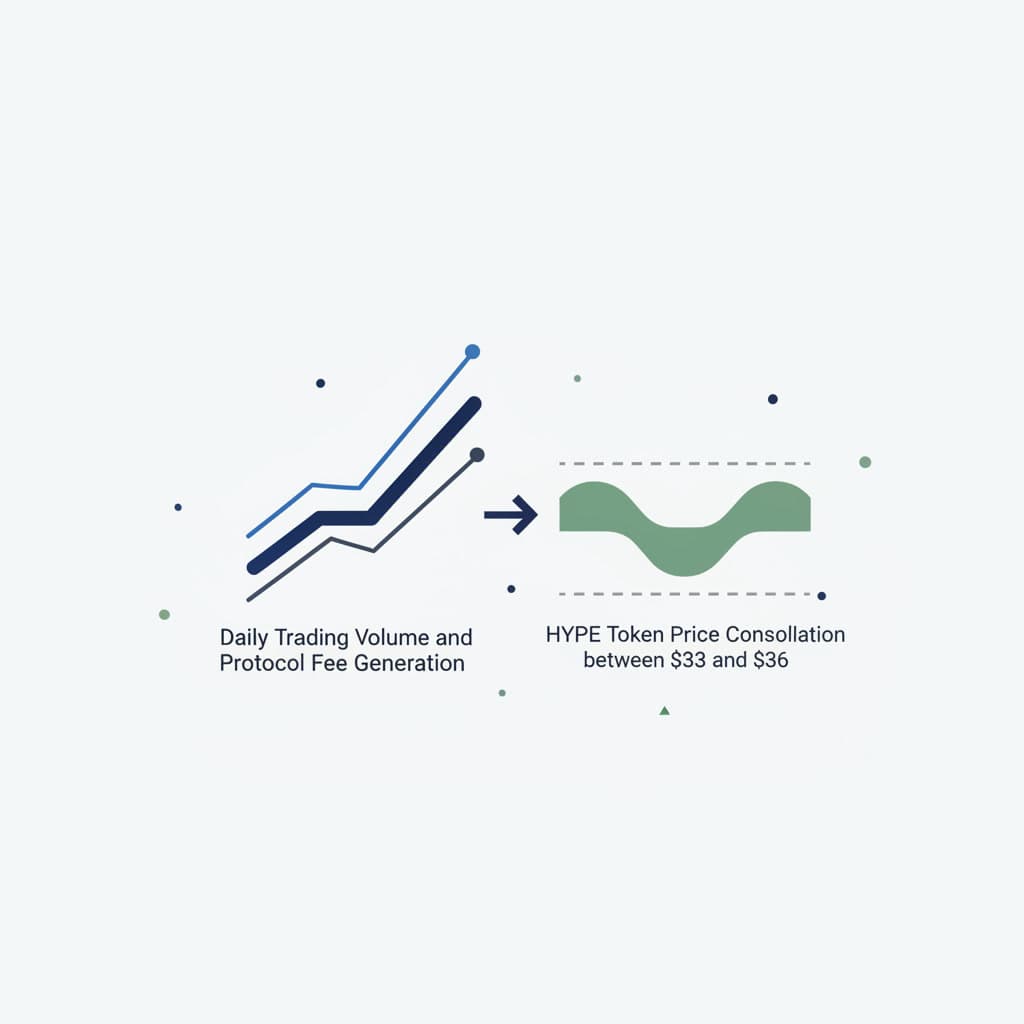
The foundational architecture of Hyperliquid relies on a ruthless efficiency loop designed to compress the circulating supply of its native asset. Unlike traditional decentralized exchanges that distribute revenue to liquidity providers or governance stakers, Hyperliquid routes approximately 97% of its trading fees directly into its Assistance Fund. This smart contract programmatically executes market buys of HYPE, effectively transforming daily trading volume into perpetual bid pressure.
This mechanism introduces profound second-order effects. For liquidity providers, the absence of direct fee sharing is offset by a highly liquid order book and maker rebates, which incentivize tight spreads. For token holders, the automated buybacks create a synthetic scarcity. When network volume spikes during periods of macroeconomic volatility, the protocol accelerates its purchasing velocity. This creates a reflexive floor: as trading activity increases, so does the capital deployed to defend the asset's price, establishing a mathematical baseline of demand regardless of retail sentiment.
A micro-structure event in early April 2026 perfectly illustrates the friction between individual execution costs and systemic protocol health. On-chain data revealed that a single entity—widely identified as the high-volume trader Machi Big Brother—incurred $1.94 million in trading fees on Hyperliquid after executing $8.35 billion in volume across 50,000 transactions.
This specific expenditure triggered immediate debate among institutional analysts regarding the sustainability of crypto trading costs. High operational and execution costs on underlying infrastructures typically compress profit margins for market makers and high-frequency traders. However, applying a traditional cost-analysis framework misses the protocol-level benefit. Because the network routes the vast majority of these fees to the Assistance Fund, the $1.94 million cost borne by one trader translated directly into programmatic buy pressure. The capital did not vanish into a centralized corporate treasury; it was instantly weaponized to absorb circulating HYPE tokens, effectively subsidizing liquidity and defending the current price consolidation zone.
Since late March 2026, HYPE has demonstrated a rigid consolidation between $33 and $36, currently trading near $35.99 despite scheduled supply expansions. Maintaining this narrow 24-hour range ($35.53 - $36.19) during an emission phase requires substantial order book depth. Institutional liquidity providers are currently deploying sophisticated market-making algorithms to capture the maker rebates offered by the protocol.
The defense of the $35.99 level is not a byproduct of retail accumulation but rather a function of institutional delta-neutral strategies. Market makers are hedging their HYPE inventory against perpetual futures, supplying thick limit orders on both sides of the book. When unvested tokens enter circulation, they hit a wall of institutional bids funded partially by the protocol's own buyback engine. This dual-layered liquidity—algorithmic market makers combined with automated protocol repurchases—creates a shock absorber capable of neutralizing sudden supply shocks.
To contextualize Hyperliquid's current market behavior, analyzing its volatility profile against established Layer-1 networks provides a clearer picture of its institutional maturation.
The data indicates that HYPE exhibits notably lower realized volatility compared to both Ethereum and Solana in Q2 2026. The aggressive fee-to-buyback ratio dampens downside price action by continuously sweeping the floor of the order book, forcing standard deviation bands to compress.
The core value proposition of Hyperliquid lies in its custom Layer-1 infrastructure, built explicitly to sidestep the latency bottlenecks of general-purpose blockchains. Legacy decentralized platforms operating on Ethereum Layer-2s or even high-throughput chains like Solana face state bloat and shared blockspace constraints. Hyperliquid utilizes HyperBFT, a consensus mechanism optimized strictly for its central limit order book, boasting capabilities of up to 100,000 orders per second with sub-second finality.
This architectural decision eliminates the need for automated market makers (AMMs) and allows the protocol to offer an execution environment that rivals centralized exchanges like Binance. When latency drops below 100 milliseconds, high-frequency trading firms can deploy traditional TradFi market-making strategies on-chain without the risk of front-running or MEV (Maximal Extractable Value) extraction, fundamentally altering the liquidity profile of the network.
The demographic composition of decentralized derivatives traders has shifted dramatically. In previous cycles, retail speculators drove the majority of perpetuals volume. By April 2026, on-chain forensics indicate a heavy skew toward institutional and programmatic volume on platforms like Hyperliquid.
The $1.94 million fee event exemplifies this transition. Retail participants simply do not generate $8.35 billion in notional volume. The platform's success is increasingly decoupled from retail hype cycles and tethered instead to its ability to attract and retain institutional flow. This reliance on whale activity presents a concentration risk; if a handful of high-volume entities migrate to a competing venue, the protocol's fee generation—and by extension, its buyback engine—would face severe contraction.
Valuing a token with a hard-capped supply of 1 billion and a 97% revenue burn rate requires modeling future cash flows and network adoption. At the current price of $35.99, the fully diluted valuation (FDV) sits just under $36 billion. Pushing toward a new all-time high (ATH) necessitates a sustained increase in the protocol's market share of the global derivatives sector.
If Hyperliquid maintains its current trajectory of capturing centralized exchange volume, the mathematical reality of constant buybacks against a fixed supply curve creates a highly convex payoff structure. However, this assumes the protocol can indefinitely sustain its high fee generation without facing aggressive fee compression from emerging competitors.
No institutional analysis is complete without mapping the regulatory perimeter. The decentralized derivatives sector faces unprecedented scrutiny from entities like the Commodity Futures Trading Commission (CFTC) and the European Securities and Markets Authority (ESMA). Regulators are increasingly targeting front-end interfaces and liquidity providers operating on permissionless order books.
If global regulators classify decentralized perpetuals as unregistered securities or illegal swap facilities, institutional market makers may be forced to withdraw their liquidity to avoid compliance violations. Such an event would widen spreads, degrade the user experience, and trigger a cascading decline in trading volume.
To navigate the future, protocols must make hard decisions regarding capital allocation and regulatory compliance. The table below outlines the strategic trade-offs Hyperliquid faces as it scales.
A sustained drop in perpetuals trading volume below $1 billion daily would fundamentally alter this supply-side thesis. If network activity contracts, the Assistance Fund’s buyback velocity would decelerate, exposing the token to unmitigated emission inflation and potentially breaking the $33 structural floor.
Hyperliquid demonstrates structural strength by maintaining the $35.99 level despite recent supply expansions. Market participants should monitor the sustainability of fee-driven buybacks and network volume shifts as primary indicators for the next macro directional move.
How does Hyperliquid's fee buyback mechanism directly affect the HYPE token price? The protocol programmatically allocates a portion of exchange trading fees to purchase HYPE tokens from the open market. This creates consistent baseline demand, which has been instrumental in defending the $35 support zone during recent supply unlock events.
Why is the $1.94M fee payment raising debates among institutional crypto analysts? High operational and execution costs on underlying infrastructures can compress protocol profit margins. Analysts are evaluating whether such significant fee expenditures limit the capital available for token buybacks and long-term treasury growth.
Loading comments...