
Deep Analysis
Solana Breaks $85 Resistance: Institutional Analysis of the Path to $100
April 14, 2026
...


On April 10, 2026, Covenant AI—the developer behind the 72-billion parameter model that previously drove Bittensor's network utility—abruptly exited the ecosystem, liquidating 37,000 TAO across three major subnets. The resulting governance dispute over emission controls and alleged centralization triggered a 28 percent collapse in the native token's valuation, wiping out hundreds of millions in market capitalization within hours. This event is not a standard retail panic; it is a fundamental stress test of decentralized machine learning architecture, exposing the fragile equilibrium between protocol governance and subnet operator incentives.
Applying a quantitative market-structure framework to Bittensor's on-chain data, the current $245.81 price level represents a critical inflection point. The network is currently caught in a sharp dichotomy: the severe liquidity shock from a top-tier operator's departure versus the stabilizing arrival of institutional capital via the newly launched TAO Institute. Establishing a definitive market floor requires looking beyond the immediate price action to trace the underlying shifts in hash rate distribution and smart money accumulation.
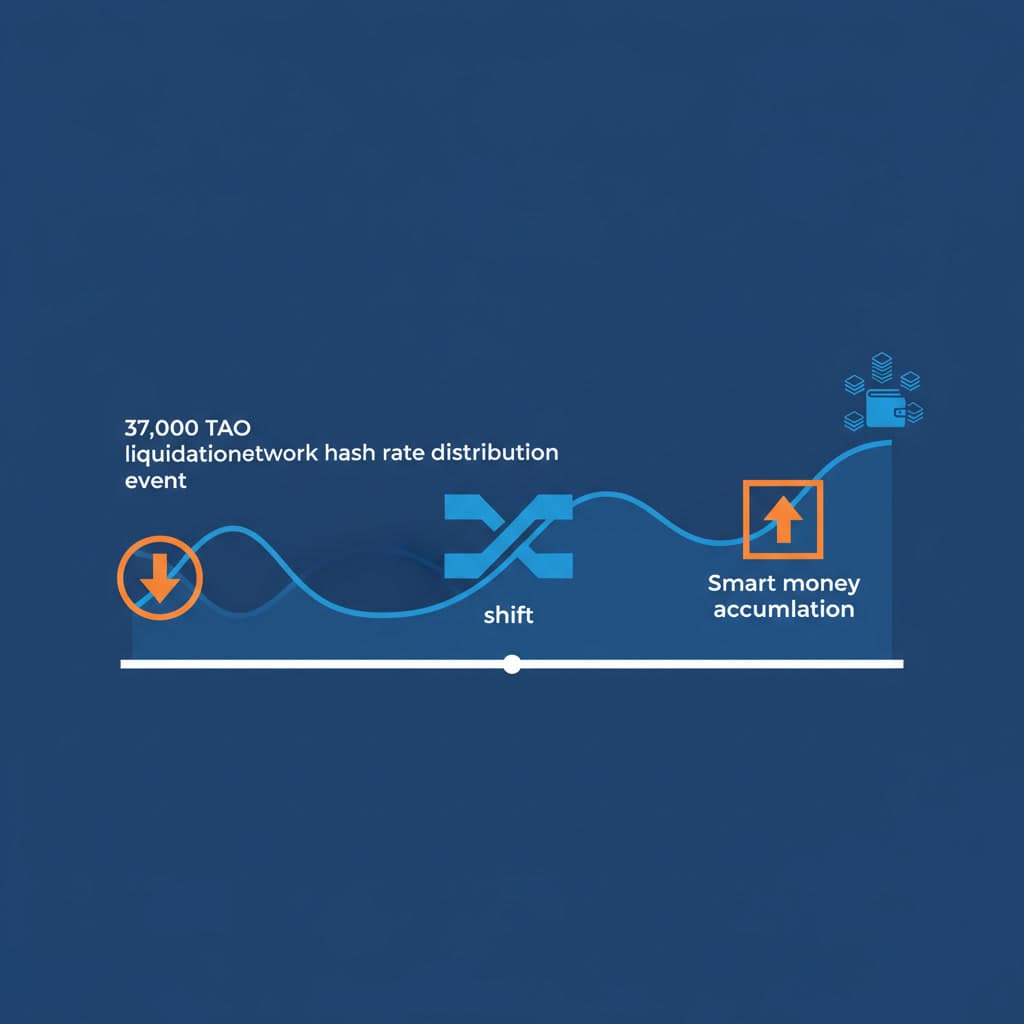
The mechanics of the Covenant AI departure reveal the inherent liquidity risks in token-incentivized networks. Operating Subnets 3 (Templar), 39 (Basilica), and 81 (Grail), the team held a substantial concentration of the network's alpha. When founder Sam Dare initiated the exit, the coordinated dumping of roughly $10 million worth of TAO into a relatively thin order book caused an immediate supply glut. Sell volume reached its highest level since December 2024, cascading through automated market makers and triggering leveraged liquidations. The token plunged from the $340 range to a multi-week low, momentarily piercing the $250 support before attempting consolidation at $245.81 according to market data.
This liquidation was not a random market fluctuation but a calculated execution. On-chain forensics indicate that sophisticated wallets began unloading positions into a breakout attempt 24 hours prior to the public announcement, using retail strength as exit liquidity. The sheer velocity of the 37,000 TAO distribution highlights the vulnerability of Bittensor's secondary markets to subnet-level concentration.
Beyond the price chart, the true damage occurred at the consensus layer. Bittensor relies on the Yuma Consensus mechanism to distribute emissions based on validator evaluations of miner performance. Covenant AI's exit effectively orphaned three high-performing subnets, forcing an abrupt reallocation of computational resources. Miners who had optimized their hardware for the Covenant-72B model pre-training tasks were suddenly left without a functioning incentive structure.
The sudden vacuum stress-tested the network's modular architecture. While the protocol is designed to be permissionless, allowing competing subnets to absorb abandoned workloads, the transition is rarely seamless. Validators had to rapidly adjust their weights, and the resulting volatility in emission distribution created a temporary distortion in validator yields. The event underscored a harsh reality: when a dominant subnet operator leaves, the cascading effect on hardware operators and validators threatens the stability of the entire machine learning marketplace.
The core of the crisis lies in a fundamental governance dispute. Covenant AI accused Bittensor's leadership of operating a "decentralization theater," alleging that founder Jacob Steeves unilaterally suspended emissions to their subnets, removed moderation capabilities, and applied direct economic pressure. These actions, whether justified as network protection or condemned as authoritarian overreach, expose the friction between protocol-level validators and subnet-level creators.
In a decentralized AI ecosystem, there is an impossible trinity of maintaining model quality, ensuring trustless neutrality, and aligning economic incentives against malicious behavior. When the triumvirate structure controlling network upgrades can seemingly override subnet operations, the foundational premise of permissionless innovation is compromised. High-profile developers require operational certainty; if governance disputes can instantly sever their economic lifeline, the network risks repelling the exact talent it needs to scale.
To quantify the fallout, an examination of the network's metrics before and after the governance shock is necessary. The 28 percent contraction in TAO's market capitalization reflects a broader repricing of risk associated with subnet concentration.
The data illustrates a rapid flight of speculative capital. The coupling of subnet performance to the overarching TAO tokenomics means that a localized failure on Subnet 3 instantly translates into a macroeconomic shock for the entire protocol.
Counteracting the retail panic is a deliberate pivot toward institutionalization. The launch of the TAO Institute, co-founded with General Tensor, represents a critical maturation point for the ecosystem. Up to this juncture, investors navigating Bittensor's 128 active subnets relied heavily on fragmented data and community sentiment—a recipe for the exact volatility witnessed during the Covenant exit.
The TAO Institute introduces the Subnet Risk Index (SRI), an open-source methodology designed to provide sell-side equivalent research coverage for decentralized AI. By standardizing risk assessment, the platform aims to attract family offices, public companies, and traditional venture funds that require rigorous due diligence frameworks before deploying capital.
While retail sentiment remains suppressed, on-chain indicators suggest a different narrative among institutional players. Following the initial liquidation cascade, trading volume spiked by 168 percent during the pullback, signaling accumulation rather than capitulation. Leveraged shorts were effectively cleared out, and entities like Yuma have continued to stake a significant portion of the total supply. Tracking the inflow of capital into wallets historically categorized as smart money reveals that the $245 to $250 range is being heavily defended as a fundamental support zone.
The Covenant crisis has catalyzed necessary architectural evolutions. To prevent future unilateral disruptions, the community is pushing for headless subnets—commoditized architectures that run without single points of failure or centralized operator control. Concurrently, the proposed Locked Stake upgrade aims to tie subnet ownership to time-locked TAO, ensuring that development teams have a verifiable, long-term economic commitment to the network before they can command significant emission shares.
These upgrades are non-negotiable if Bittensor intends to retain its position as the premier decentralized AI network. Transitioning from operator-dependent silos to truly permissionless, protocol-owned infrastructure will dictate the network's survivability through the remainder of 2026.
Valuing TAO at $245 requires discounting the short-term governance premium while pricing in the long-term institutional infrastructure being built. The exit of a major player, while painful, effectively stress-tested the protocol's redundancy. The open-source nature of the models means community miners are already working to revive the affected subnets. If the TAO Institute successfully bridges traditional capital, the current valuation may represent a steep discount relative to the network's aggregate computational output.
A sustained failure to implement the Locked Stake upgrade or a continued exodus of top-tier AI researchers from the remaining 125 subnets would invalidate the bullish institutional thesis. If the governance structure remains entirely reliant on a centralized triumvirate without transitioning toward verifiable, decentralized consensus for network upgrades, the decentralization theater critique will solidify into structural permanence, capping TAO's long-term valuation potential.
At a valuation of $245.81, Bittensor is navigating the most precarious phase of its lifecycle. The Covenant AI exit violently stripped away the speculative excess, exposing the raw, unresolved tensions between protocol governance and subnet autonomy. Yet, the simultaneous launch of the TAO Institute provides the exact institutional scaffolding required to rebuild market confidence. The network's ultimate trajectory will not be determined by the developers who left, but by the protocol's ability to enforce transparent, economically aligned governance for the capital that remains.
How does the exit of a major subnet operator like Covenant AI affect Bittensor's fundamental utility? While an operator exit triggers short-term volatility and redistributes token emissions, Bittensor's modular architecture is designed to allow competing subnets to absorb the abandoned workload, ensuring the underlying decentralized machine learning infrastructure remains operational.
What role does the TAO Institute play in the ecosystem's recovery? The TAO Institute functions as a strategic bridge for institutional capital, providing rigorous research and structuring frameworks designed to offset retail panic selling by attracting long-term, high-net-worth liquidity into the network.
Loading comments...