


Asymmetric Hydric-Energy Targeting: The Next Black Swan for Utility Markets
Asymmetric Hydric-Energy Targeting: The Next Black Swan for Utility Markets
The global financial apparatus remains disproportionately fixated on crude oil supply shocks, fundamentally mispricing the Middle East’s true systemic vulnerability: manufactured water. Drawing on over 15 years of quantitative data science experience modeling sovereign credit and infrastructure derivatives, my analysis applies probabilistic catastrophe frameworks to evaluate this rapidly escalating threat vector. The escalation of Middle Eastern geopolitical conflicts has triggered a fundamental shift in military doctrine, moving away from conventional battlefield engagements toward the explicit targeting of civilian lifelines. Readers will understand the mechanics of asymmetric strikes on combined desalination and power plants, and how institutional capital is fundamentally repricing the systemic risk of catastrophic utility disruptions. For context on sovereign exposure, credit rating agencies like S&P Global and Fitch Ratings have recently highlighted how prolonged hostilities threatening energy and water infrastructure directly pressure regional sovereign debt instruments.
The Strategic Pivot Toward Civilian Lifelines
Redefining Acceptable Targets in Modern State Conflict
Historically, kinetic engagements in the Persian Gulf concentrated on oil refineries and maritime export routes. Recent tactical developments indicate a deliberate recalibration toward critical life-support systems. State actors and proxy networks now possess precision munitions and loitering drones capable of bypassing conventional air defenses to strike municipal water and power sources. This evolution weaponizes the basic survival requirements of civilian populations, forcing opposing governments to divert immense capital toward domestic pacification and emergency logistics rather than offensive military operations.
The Desalination-Power Nexus as a Single Point of Failure
The architecture of Middle Eastern utilities relies heavily on co-located facilities. Producing potable water from the Persian Gulf requires extreme energy inputs, dictating that thermal desalination and reverse osmosis plants are physically integrated with gas-fired power stations. This water-energy nexus creates an unparalleled single point of failure. A precise strike disabling the power generation turbine simultaneously halts the desalination process. Given that countries like Kuwait and Qatar depend on these integrated complexes for up to 90% of their municipal drinking water, disabling a single mega-facility instantly threatens millions of residents and halts regional industrial output.
Quantifying the Hydric-Energy Risk Premium
How Derivative Markets are Pricing Utility Catastrophes
To isolate the financial impact of these threats, we must examine the repricing of utility derivatives. A clear case study emerged in early March 2026 following reported drone activity near the Fujairah F1 power and water complex and the Qeshm Island desalination plant. While physical damage was contested, quantitative hedge funds immediately adjusted their probabilistic risk models. The yield spread on Gulf Cooperation Council (GCC) utility bonds widened significantly within 72 hours. Institutional investors simultaneously increased their volume in parametric catastrophe swaps—instruments that trigger automatic payouts if regional power output drops below a predefined megawatt threshold, bypassing the lengthy claims adjustment process of traditional indemnity policies.
Insurance Capacity and the Uninsurable Infrastructure Gap
The concentration of asset values along the Gulf coast presents a severe constraint for global reinsurers. Traditional underwriting models rely on geographic diversification, which fails when a single coordinated drone swarm can simultaneously degrade multiple multi-billion-dollar facilities. Consequently, insurance capacity for coastal mega-facilities is shrinking. Premium rates for terrorism and political violence coverage have surged, forcing state-owned utility operators to self-insure or seek alternative risk transfer mechanisms through sovereign wealth funds. This uninsurable infrastructure gap leaves national balance sheets directly exposed to the total replacement cost of these assets.
Anatomy of Retaliatory Strikes on Gulf Infrastructure
Vulnerability Profiles of Coastal Mega-Facilities
The physical footprint of a combined power and desalination plant is inherently difficult to defend. These facilities feature massive, exposed intake pipes, sprawling membrane filtration halls, and highly volatile fuel storage tanks. Beyond direct ballistic impacts, these plants are highly susceptible to intake contamination. An asymmetric tactic involves deliberately rupturing nearby oil infrastructure or deploying chemical agents into the maritime currents feeding the plant. Once hydrocarbons enter a reverse osmosis intake, the delicate filtration membranes are irreversibly fouled, requiring months of costly replacement and effectively neutralizing the plant without a direct kinetic strike on the water facility itself.
Cascading Failures from Water Scarcity to Industrial Grid Collapse
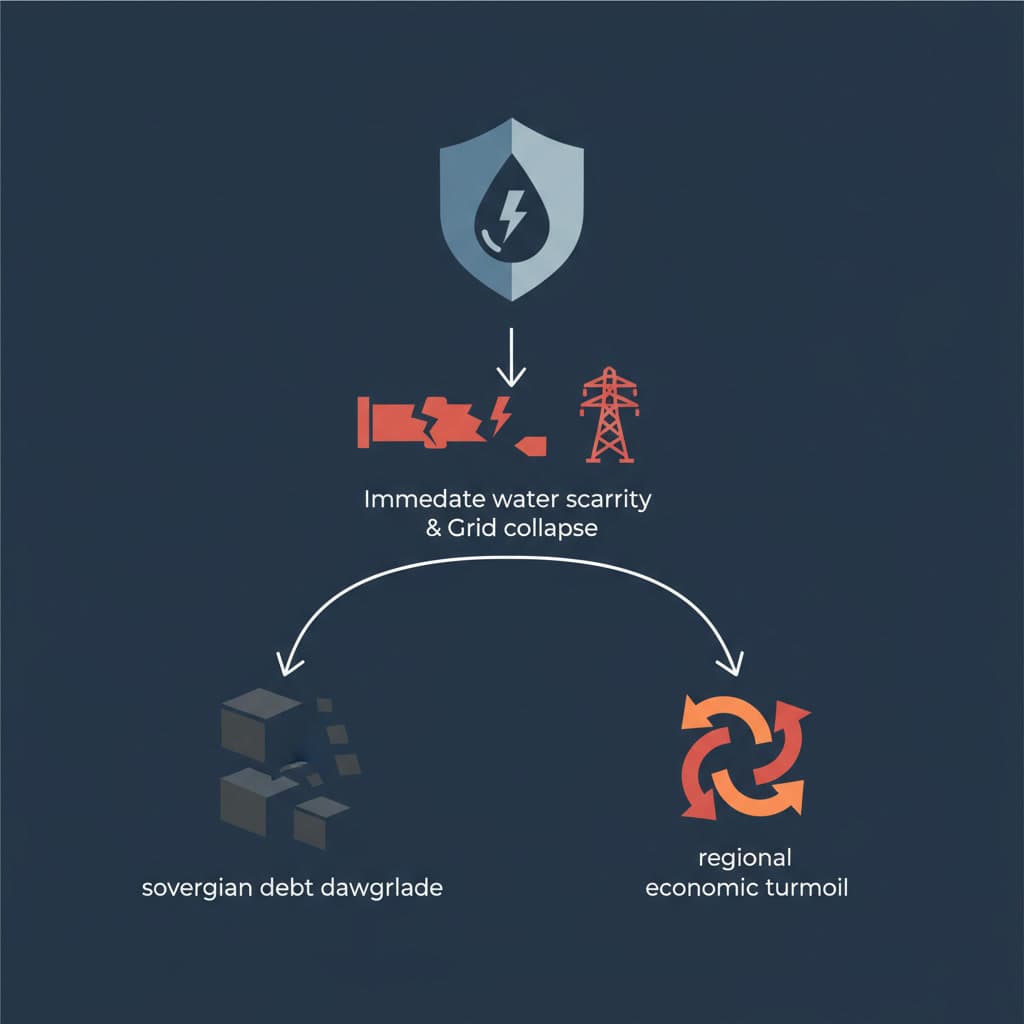
The second-order effects of asymmetric hydric-energy targeting extend far beyond dry taps. Water is the primary cooling agent for regional petrochemical refineries, data centers, and heavy manufacturing. A sudden drop in desalinated water pressure forces these secondary industries to initiate emergency shutdowns to prevent catastrophic overheating. This sudden shedding of industrial electrical load destabilizes the broader power grid, potentially triggering cascading blackouts. The economic multiplier effect of such an event is severe, transforming a localized infrastructure failure into a widespread macroeconomic contraction within days.
Reshaping Sovereign Credit and Investment Mandates
Downgrading Regional Utility Debt Instruments
Credit rating agencies are actively institutionalizing these threat vectors into their sovereign models. Fitch Ratings and S&P Global have integrated negative qualitative overlays for Middle Eastern sovereigns facing elevated infrastructure risks. The baseline assumption is no longer uninterrupted utility operation. When evaluating the debt instruments of state-owned water and electricity authorities, analysts now heavily weight the geographic concentration of production. A downgrade in these utility bonds directly increases the sovereign's borrowing costs, restricting the fiscal space available for economic diversification initiatives.
The Financial Push for Decentralized, Hardened Microgrids
Looking forward through 2026 and into the next decade, institutional capital mandates are forcing a structural pivot in how utility infrastructure is engineered. The strategic vulnerability of centralized mega-facilities is driving aggressive investment into decentralized, hardened microgrids.
These microgrids combine localized solar generation with modular, containerized atmospheric water generation or small-scale desalination units. By distributing the generation capacity across hundreds of independent, off-grid nodes, governments and private equity sponsors can mathematically eliminate the single-point-of-failure risk. This decentralization fundamentally alters the calculus of asymmetric warfare, rendering large-scale civilian disruption prohibitively expensive for the attacker.
The era of assumed utility security has officially ended. Institutional investors and risk managers must now monitor Middle Eastern sovereign bond spreads, specialized catastrophic swaps, and infrastructure insurance premiums as primary indicators of escalating asymmetric threats.
FAQ
What exactly is asymmetric hydric-energy targeting? It refers to military or proxy strategies that focus on disabling critical water and power infrastructure—specifically combined desalination and power plants—to inflict disproportionate economic and societal damage without engaging conventional armed forces.
How are financial markets currently hedging against this specific infrastructure threat? Institutional investors are leveraging specialized catastrophic risk swaps, shorting regional utility bonds, and aggressively increasing capital allocations to decentralized, off-grid water and energy generation technologies.
Sources
- S&P Global: Middle East Conflict Is Starting To Strain Credit Channels Across Sectors
- Fitch Ratings: Middle East sovereign ratings face risks from prolonged conflict
- Center for Strategic and International Studies (CSIS): Could Iran Disrupt the Gulf Countries' Desalinated Water Supplies?
- World Economic Forum: The water-energy nexus
- Department of Energy: The Water-Energy Nexus
- The Water Diplomat: Freshwater desalination plants under attack in the Middle East?
Loading comments...
Related
View all →