

The Silent Interface: How Agentic Abstraction Kills the Crypto Learning Curve
The Silent Interface: How Agentic Abstraction Kills the Crypto Learning Curve
The prevailing narrative in Web3 UX design—that we must educate users to manage keys, understand gas topology, and navigate bridges—is fundamentally flawed. Mass adoption will not come from making these processes easier to understand; it will come from making them invisible. We are witnessing the death of the "user-as-network-engineer" model.
The industry is currently pivoting toward Agentic Abstraction. This is not merely an iteration of Account Abstraction (ERC-4337), which smoothed out login processes, but a radical architectural shift where AI agents replace humans at the execution layer. In this paradigm, the user provides the intent (the "what"), and an autonomous agent handles the execution (the "how").
This transition effectively bifurcates the crypto economy: the settlement layer remains a deterministic, verify-first environment, while the interaction layer becomes probabilistic and agent-driven. For investors and developers, this signals that the value capture is moving away from generic dApp front-ends and toward the AI solvers that control order flow.
Beyond Account Abstraction: The Rise of Intent-Centric Architectures
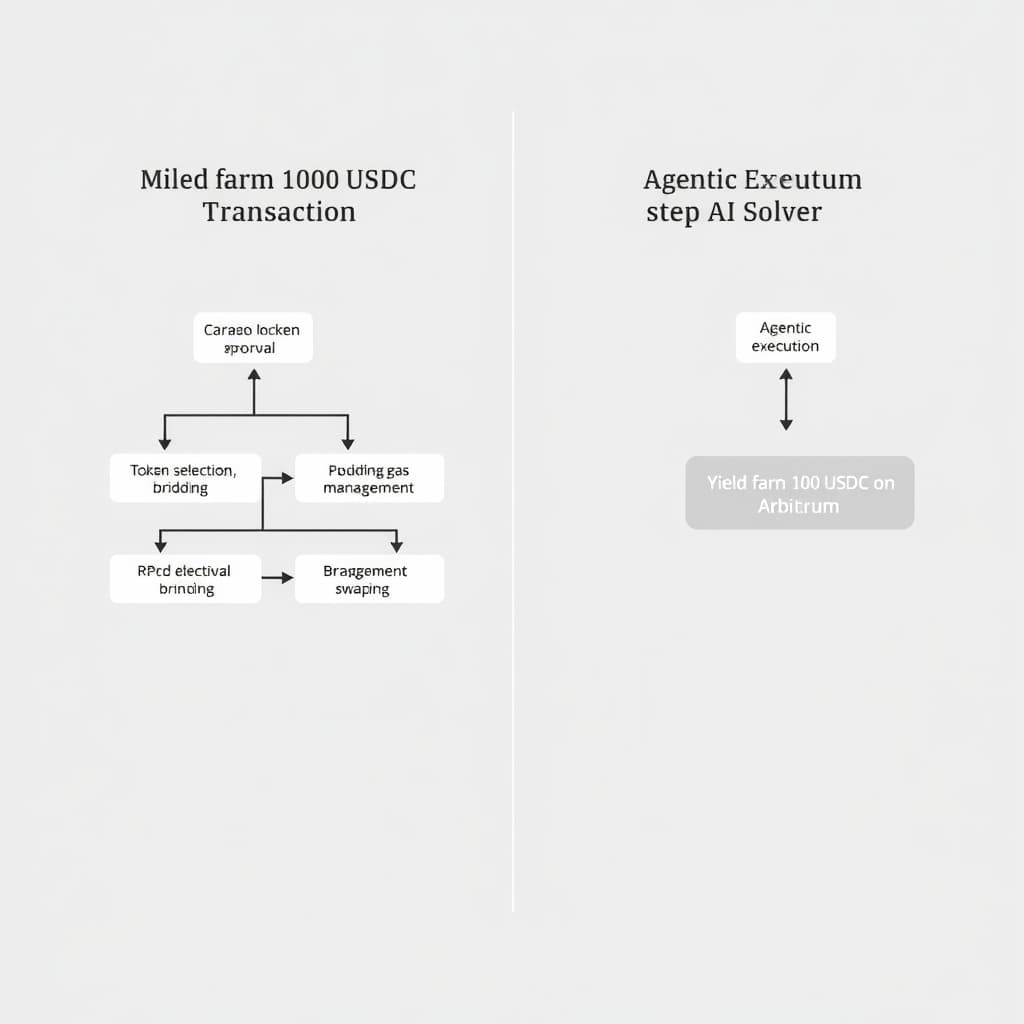
Current blockchain interactions are imperative. To swap a token, you must tell the chain exactly which contract to call, how much gas to pay, and which nonce to use. If any parameter is wrong, the transaction fails. Agentic abstraction relies on Intent-Centric Architectures, where the user defines a desired end-state, and off-chain actors (solvers) compete to fulfill that state.
From Imperative Transactions to Declarative Outcomes
The shift from imperative to declarative interaction is the single biggest reduction in cognitive load in crypto history. In an imperative model, the user bears the burden of execution complexity. In a declarative model, the user bears only the burden of articulating desire.
Consider the friction differential:
How Solvers Negotiate Best Execution
The "magic" happens in the mempool—or rather, a new layer above it. When a user broadcasts an intent (e.g., "Exchange 1 ETH for maximum USDC"), they are not talking to a smart contract directly. They are broadcasting a request to a network of Solvers—specialized bots and AI agents.
These solvers simulate various execution paths off-chain. One might route through Uniswap; another might use a private market maker; a third might bridge to an L2 where liquidity is deeper. The solver that offers the best price net of fees wins the right to execute the transaction. This turns execution into a competitive market rather than a direct service call, theoretically compressing slippage and fees for the user.
The Invisible Wallet: Delegating Custody to Algorithms
The concept of "self-custody" is evolving from holding a static private key to managing a hierarchy of permissions. The anxiety of losing a seed phrase is a product of poor architecture, not a feature of decentralization.
Replacing Seed Phrase Anxiety with Biometric Permissions
Agentic wallets utilize Multi-Party Computation (MPC) and session keys to fragment custody. The user retains the "master key" (often secured via hardware enclave or biometrics), but the AI agent holds a "session key" with limited privileges.
This mirrors the banking world. You do not authorize every database entry your bank makes; you authorize the bank to act on your behalf within limits. In Web3, users will grant agents an "allowance" of time and value—for example, "You are authorized to trade up to $500 of my portfolio per day." If the agent is compromised or malfunctions, the damage is capped, and the master key remains safe.
The Shift from Direct Protocol Interaction to Mandates
We are moving toward "Mandate-Based" crypto interaction. Instead of clicking buttons on a DeFi dashboard, users will issue mandates.
- Old Way: User manually claims rewards, re-stakes them, and compounds interest weekly.
- Agentic Way: User issues a mandate: "Maintain a delta-neutral position on ETH and auto-compound yields."
The agent monitors the chain 24/7. When conditions are met, it executes the transaction using its session key. This creates a "set it and forget it" user experience that is currently impossible with standard EOAs (Externally Owned Accounts).
The Oracle Problem 2.0: Trusting the Black Box
While agentic abstraction solves UX, it introduces a severe verification problem. If an AI agent effectively controls the user's interface, how does the user know the agent isn't hallucinating—or worse, malicious?
Verification Mechanisms for Asset Safety
We cannot rely on blind trust in LLMs, which are probabilistic engines prone to error. The solution lies in Trusted Execution Environments (TEEs) and Zero-Knowledge Machine Learning (zkML).
- TEEs: Hardware-level isolation (like Intel SGX) ensures the agent runs the exact code it claims to run, without external tampering.
- zkML: Allows the agent to generate a cryptographic proof that its output (the transaction it constructed) is indeed the result of the user's input (the prompt) and the current market data, without revealing private data.
Without these verification layers, agentic crypto is simply a return to centralized banking with extra steps.
Standardizing Agent-to-Protocol Communication
For agents to function, protocols must be readable by machines. Currently, most dApps are designed for human eyes (HTML/CSS). We are seeing a push for standardized Agent Interfaces—APIs and smart contract metadata that allow AI agents to query liquidity, fees, and risks without scraping a frontend. If a protocol does not expose an agent-friendly endpoint, it will effectively be invisible to the 2026 market.
2026 Market Maturity: When Agents Replace Interfaces
By 2026, the primary user of a blockchain will not be a human; it will be a bot. This shift forces a complete re-evaluation of where value accrues in the stack.
The Decline of Generic Front-Ends
The generic "Swap Interface" (e.g., the standard Uniswap or Aave frontend) becomes obsolete. Users will interact with a personalized dashboard or a chat interface that aggregates all protocols. The dApp frontend becomes a vestigial organ—a marketing landing page rather than a functional tool.
Map of Incentives: Who Wins and Loses?
The introduction of agentic intermediaries redistributes profit pools.
Conclusion
We are approaching a singularity in Web3 UX where the blockchain recedes into the background, functioning purely as a settlement rail. The "Silent Interface" of agentic abstraction promises to kill the steep learning curve that has stifled adoption for a decade. However, this convenience demands a new vigilance: we are trading the risk of user error for the risk of algorithmic opacity. The winners of the next cycle will be those who can build agents that are not only capable but provably honest.
FAQ
How does Agentic Abstraction differ from standard trading bots?
Standard trading bots operate on rigid
if/then logic scripts (e.g., "If Bitcoin hits $90k, sell"). Agentic abstraction utilizes Large Language Models (LLMs) combined with solvers to interpret vague, high-level goals (e.g., "Rebalance my portfolio to low-risk assets") and navigate complex, changing environments without explicit step-by-step instructions.Does using an AI agent mean losing self-custody of assets? Not necessarily. In a properly architected system, the user retains the master key (self-custody) while granting the agent limited, revocable permissions (allowances) to execute specific tasks. This is similar to how you approve a smart contract to spend a specific token today, but with more sophisticated logic and time-bounds.
Sources
Loading comments...
Related
View all →


Crypto
Enterprise Stablecoin Inflection: Why Corporate Finance is Nearing its 'ChatGPT Moment'
March 28, 2026
...