
XRP's Institutional Turning Point: Assessing the $1B Treasury Firm Nasdaq Debut and CLARITY Act Impact

XRP's Institutional Turning Point: Assessing the $1B Treasury Firm Nasdaq Debut and CLARITY Act Impact

Author vaultxai
...
4 min read
#Deep Analysis

The current $1.43 consolidation in XRP is not a symptom of retail fatigue, but rather a deliberate, structural transfer of float from speculative derivatives markets into regulated corporate treasuries. By evaluating order book depth, SEC Form S-4 filings, and Senate legislative markups, a distinct pattern emerges. The market is transitioning from high-leverage price discovery to low-velocity institutional accumulation. This analysis applies a market microstructure framework to quantify the impact of two colliding variables: the proposed $1 billion Nasdaq-listed Evernorth treasury firm and the Senate Banking Committee’s advancement of the CLARITY Act.

Deconstructing the $1 Billion Nasdaq Treasury Play

How Publicly Traded Treasury Firms Alter Supply Dynamics

Evernorth Holdings recently filed a Form S-4 with the U.S. Securities and Exchange Commission to execute a $1 billion SPAC merger with Armada Acquisition Corp. II, targeting a Nasdaq listing under the ticker XRPN. Unlike an exchange-traded fund (ETF) that passively tracks price, a treasury firm actively removes circulating supply and locks it on a corporate balance sheet. On-chain data indicates the firm has already accumulated approximately 473 million tokens.

  • Mechanism: The firm utilizes equity capital to purchase spot XRP, creating a persistent supply sink.
  • Implication: When tokens are absorbed by a corporate treasury, the available float on spot exchanges shrinks. This structural illiquidity amplifies upward price responses during demand shocks.
  • Example: MicroStrategy pioneered this exact playbook with Bitcoin. Evernorth applies the same logic to XRP, but introduces a yield-generating component by participating in decentralized finance (DeFi) on the XRP Ledger using the RLUSD stablecoin.

Historical Precedents of Institutional Wrappers on Token Velocity

When institutional wrappers acquire digital assets, token velocity—the rate at which a single unit of currency is transacted—plummets.

FeaturePassive Spot ETFActive Treasury Firm (SPAC)
Primary ObjectivePrice tracking via creation/redemptionPer-share value growth via active yield
Supply ImpactVariable (dependent on daily flows)Permanent supply sink (held on balance sheet)
Yield GenerationNone (pure spot holding)Active (Lending, Liquidity Provision, DeFi)
Market MicrostructureHigh correlation to retail sentimentDecoupled equity premium potential

By shifting tokens into an active treasury vehicle, the market isolates a massive portion of the supply from daily speculative trading, drastically reducing the liquidity available to absorb sudden buy walls.

Open Interest and Derivatives Market Signals

Analyzing the 2025 Open Interest Fractal

Derivatives markets have experienced a total structural reset. Over the past five months, XRP lost hundreds of millions in leveraged futures positions. Total open interest collapsed from $660 million in October 2025 to roughly $203 million by early March 2026.
  • Mechanism: When open interest drops alongside a price decline, it indicates the capitulation and clearing of leveraged long positions. The estimated leverage ratio on major venues like Binance has dropped from 0.6 to near 0.17.
  • Implication: The market is currently deleveraged. Without a heavy overhang of long positions, the risk of cascading liquidations is neutralized. Spot buying can now drive price discovery without futures-driven resistance.
  • Example: The April 2025 fractal perfectly mirrors this setup. During that period, open interest bottomed near $270 million while the spot price sat around $1.80. The subsequent spot-driven demand triggered a 103% rally to $3.65 by July.
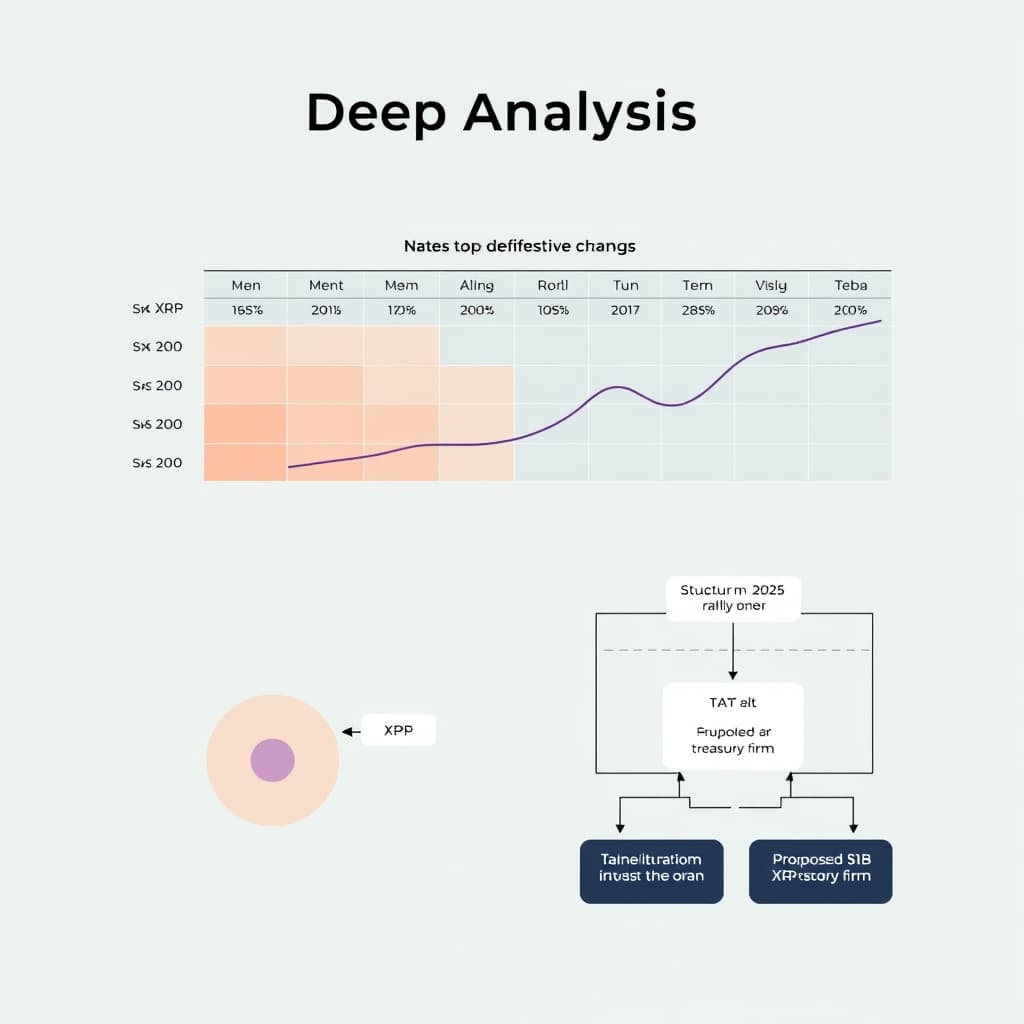
Flow diagram and data matrix showing XRP open interest fractal and Evernorth Nasdaq treasury structure
Visual:Flow diagram and data matrix showing XRP open interest fractal and Evernorth Nasdaq treasury structure
MetricApril 2025 (Pre-Rally)March 2026 (Current)
Total Open Interest~$270 Million~$203 Million
Estimated Leverage Ratio0.210.17
Spot Price$1.80$1.43
Subsequent Price Action+103% (to $3.65)Pending

Liquidation Zones Between the $1.11 Support and $1.50 Resistance

Options market data reveals a heavy cluster of call activity around the $1.60 strike. The immediate resistance lies between $1.51 and $1.60, representing the supply zone from the late 2025 rally where trapped buyers are seeking exit liquidity. Conversely, the $1.11 level serves as a hard structural support. Institutional limit orders are stacked heavily in this lower bound, creating a floor that prevents deeper capitulation.

The CLARITY Act and Institutional Bank Adoption

Legislative Mechanisms Enabling On-Balance Sheet Crypto

The Digital Asset Market CLARITY Act is currently advancing through the Senate Banking Committee, fundamentally altering the regulatory landscape for digital assets in the United States.

  • Mechanism: The legislation draws a definitive jurisdictional boundary, classifying assets like XRP, Bitcoin, and Solana as digital commodities. This framework places them under the purview of the Commodity Futures Trading Commission (CFTC), superseding the SEC's historical regulation-by-enforcement approach.
  • Implication: By removing the threat of unregistered securities offerings, the Act dismantles the punitive capital requirements that previously prevented commercial banks from holding digital assets.
  • Example: SEC Chair Paul Atkins recently issued an

Loading comments...